Tuesday, April 22, 2014

Witbooi Native Auxiliaries in 25mm

Witbooi Nama Native Auxiliaries (Monday Knight Productions Haitians 25mm)
A troop of about 110 native auxiliaries from the Witbooi tribe served with the Germans in the Herero War of 1904.  Contemporary images suggest that they went to war wearing their traditional white turbans around their wide brimmed hats.  In previous campaigns they wore imperial armbands over civilian clothing to distinguish them from the enemy, and that is how I have depicted them with these figures.

The miniatures are 25mm, too small to work well with the 28mm figures that comprise the bulk of my forces on the gaming table but adequate when used as a group on their own.  They are from
Monday Knight Productions Banana Wars Haitian Figures line and have been modified with Kneadatite epoxy putty tape to add turbans to their hats.  These are simple sculpts and very affordable at $12 for a mixed squad of nine different men with rifles and one of two leader types with pistols and machetes.  Three are without hats and I have assigned them to the Herero forces to round out some smaller sized units.  They can also be purchased singly.

Instead of wheat-based cat litter I used beach sand to texture the bases.  I think it will require a second coat of white glue and additional sand to get the right amount of ground cover, but it avoids the problem of the wheat absorbing liquid and the longer associated drying time.

Just 24 figures are needed to represent the Witbooi troops in the Jones/Alvaredo Herero Wars
Scenario and Rule Book and I may decide to acquire the remainder from Monday Knight.  Alternatively, I may consider these an interesting experiment and use 28mm figures instead.
Witbooi Native Auxiliaries modified with Epoxy turbans

Saturday, March 8, 2014

Typhus at Onjatu


This Wikimedia Commons archival image is thought to show a German staff wagon and officers in bivouac at Onjatu during the German-Herero war of 1904.    Oddly, a caption that accompanies another watermarked, electronic version of this image incorrectly identifies one of the officers who "writes his report on a barrel" as Oberleuntant "Stuhlmann of the German colonial troops."  There is, in fact, no officer writing on a barrel in this photograph, but there is in a different picture (viewable here) that does appear to be captioned correctly and in which presumably the officer is Stuhlmann. 

Onjatu (known today as Okondjatu, and also depicted by that name on contemporary German maps) is situated northeast of Okahandja and Southest of Waterberg.  It was the site of the German military encampment where von Glasenapp's Ostabteilung redeployed following ambush at Owikokorero (March 13, 1904) and to which it returned after the disaster at Okaharui (April 3, 1904).  Von Glasenapp remained at Onjatu until April 21 when he pulled back further to Otjihaenena to what became essentially a hospital camp, for it was during the April encampment at Onjatu that typhoid fever first broke out and ravaged the troops.

As was common in colonial conflicts in an age before modern medicine and further exacerbated by  poor sanitation discipline, the Germans lost large numbers of men to disease during the Herero war.  Although southwest Africa has malaria (especially during the rainy season), a greater threat to the Germans at Onjatu were diseases brought on by unsanitary conditions that were ideal for the spread of dysentery and  typhus.  A lack of attention to sanitation by officers and senior NCOs -  8 officers had been killed, 4 wounded and 2 invalided from a total of 22 since March 13-  and poor morale after two major defeats undoubtedly contributed to the unhealthy condition of von Glasenapp's bivouac.

Nearly 1 in 4 of all the German troops deployed in southwest Africa between January 1904 and April 1907 contracted typhus, an astounding 4,737 recorded cases of the disease.  439 died from its effects. During 1904 there were 283 deaths from disease: all but 22 of them from typhus.  The disease caused more German deaths during this year than took place on the battlefield.  87 men in von Glasenapp's depleted force contracted typhus, and the remainder were placed in quarantine at Otjihaenena.

In fact, there is a better caption for the image at the top of this post.  It comes from Kurd Schwabe's Der Krieg in Deutsch-Südwestafrika, 1904-1906 , and it clearly identifies the command wagon as von Galasenapp's, and it seems as if the seated officer were the Seebataillon major himself.
 

Sunday, March 2, 2014

Hauptmann Hugo von François

Hauptmann Hugo von Francois,  from his Nama under Damara. Deutsche Süd-West Afrika (1896)
The first German military force posted to Southwest Africa in arrived in June, 1889 and consisted of 21 officers and men under Hauptmann Curt von François (1852-1931).  The " François Troop" was actually a mercenary force under private contract for three years service, and did not formally become an imperial military force until 1894.  Hauptmann von François was accompanied by his younger brother Hugo (1861-1904) , the man with the splendid handlebar mustache, above. 

The von François brothers came an aristocratic German family of Hugenot ancestry.  Their grandfather Karl von François served against Napoleon in 1812-1813 as a junior officer with the Russian Sumschen Hussars and ended his military career as a Prussian Lieutenant General.  Their father, Generalmajor Bruno von François, died leading his division in 1870 at Spicheren, Lorraine, during the Franco-Prussian War.  Another François brother - Hermann (1856-1933) was a highly decorated  German General de Infantrie during WWI - Pour le Mérite with oak leaves - who played a decisive role in several battles on the Eastern Front including Tannenberg. 

Hugo von Francois started his military career in the 26th Regiment and was adjutant of is 2nd battalion before posting to Africa.
Schutztruppen in early uniforms with Commander Leutwein (circa. 1894-1896)
During his service in the François Troop, he was promoted to Lieutenant (1891) and Hauptmann (1896).  In his portrait photograph he wears a brown corduroy dress uniform with the pips of an oberleutnant on his shoulder and a spiked pith helmet, That style of helmet is also visible in the photograph at right from the archives of the Polytechnic Institute of Namibia, which shows a number of Schutztruppen with Theodor Leutwein, who replaced Curt von François in 1894.  Most of these men are in early (1891-1896) Schutztruppe cord uniforms with Polish-style pointed cuffs, but there are two spiked pith helmets worn by the men standing at the extreme left and right of this group.

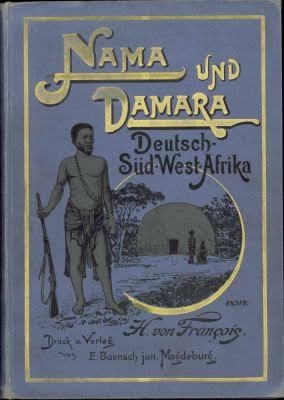
Hugo von François wrote Nama und Damara: Deutsche Süd-West Afrika (1896) in which he promotes the development of the colony by utilizing native labor (and cattle).  It includes many photographs and illustrations not often seen in other contemporary accounts, such as this non-commissioned officer mounted "Herero-style" on a bull.

Curt von François only spent five years in German Southwest Africa, but his brother Hugo, who later served in 4. Grenadier Regiment, retiring from from military service in 1899, returned as a settler with his family in 1901.  He was a Captain in the Reserves when the German-Herero war began.  He moved his family to Windhoek and prepared its defense.  In February, 1904, he accompanied the Ost-Abteilung under Major von Glasenapp and was killed on March 13th at Owikokorero.

Friday, February 21, 2014

Scenics: Two Southern African Vultures

Vultures and carcass by Wargames Foundry (GPR63)


I'm a conservationist by trade, and did a lot of birdwatching in southern Africa in the 1990s when I lived and worked in Namibia.  It is not surprising, then, that my German-Herero War in miniature project includes scenic elements representing the indigenous fauna.  Yesterday I finished this scenic vignette of two vultures squabbling over the barest of bones.

The miniatures are from Wargames Foundry and I painted them up as two vulture species that occur in Namibia today, though they are less common than they once were.  On the left is a whiteheaded vulture (Trigonoceps occipitalis) and on the right is a lappet-faced vulture (Torgos tracheliotus).  They are competitors, and the lappetfaced vulture is dominant and will drive the other away from the food source: in this case the dismembered remains of a quadruped carcass, perhaps a small antelope, army mule or a calf from the Herero cattle herd.  I think this will add a nice, somewhat macabre touch to my gaming table.


Painted Honourable Lead Boilersuit Company Schutztruppe

The Honourable Lead Boilersuit Company no longer produces 28mm figures from its German Colonial line, but I have been fortunate to find several lots on eBay that have allowed me to put both mounted and dismounted Schutztruppe in the field.  I've repainted, and in some cases rebased them, and can now put four HLBS Co. officers, a senior NCO, seven riflemen and a maxim gun team on the field, along with the first of ten painted mounted figures.  A few of these have been previewed here before, but yesterday I finished the vast majority of them and a photo gallery appears below.

There are three duplicate poses, although in one case the figure has a bread bag and canteen that its twin for some reason lacks.  I painted them in different uniforms (khaki feldrock or kord waffenrock), which is particularly striking when comparing the two officers, below.

HLBS Co. German Schutztruppe painted for Southwest Africa, 1904

Major (left) in kord waffenrock uniform; Hauptmann (right) in khaki feldrock

Three figures painted in kord waffenrock uniforms

3 figures in kord waffenrock and the same three 3 in khaki feldrock
Command Group (Hauptmann, Oberleutnant Adjutant, Hauptmann, Major, Feldwebel) and mounted Ritter

Maxim Gun team and Feldwebel


Saturday, February 15, 2014

Copplestone Askari Conversion to Rehoboth Baster Abteilung

Copplestone Darkest Africa Zanzibari Regulars Marching
Copplestone Askari Converted to Baster Abteilung


There were two Copplestone Zanzibari Askaris in a mixed set of German colonial miniatures that I picked up a few months ago on eBay, and this week I decided to do a test conversion of one of them to see whether it would work for the German-Herero war as a native auxiliary from the Baster Abteilung.  The Rehoboth Basters or Bastards are of mixed ethnicity, and one photograph of the unit that served with the Germans during 1904-1907 shows them in light colored German corduroy uniforms with the white litzen removed from the collar and sleeves.

I had some Kneadatite epoxy putty, the "green stuff" that modelers and sculptors use for conversions, so I left one figure alone and gave the other shoes and a peaked feld cap, complete with a small imperial cockade.  In 24 hours this had hardened and was ready to paint.  I painted ed it up and based it tonight and am very pleased with the result.

 Possibly I'll try to sculpt more ammunition pouches with a cavalry harness, but for now this is more than good enough.  I may go back and make the cap a darker brown, and I need to add a couple of silver buttons on each sleeve, but otherwise it is finished and I have decided to complete my Baster unit with similar conversions of  Copplestone's Zanzibari Askaris Marching sets. 


Wednesday, February 12, 2014

The Problem with Peter Moor

Evaluating and interpreting primary source material is essential to historical inquiry.   The perspectives of participants in a colonial war such as was fought in 1904 in German Southwest Africa (DSWA) can be profoundly revealing, but one should be wary of accepting them uncritically.  Personal narrative by its very nature is unique to the individual and reflects the time and circumstances in which it is written.  Military after-action reports are likewise drafted with personal and cultural biases, not to mention political considerations.  Even methodical official campaign histories - bloodless prose and all - still embody the values and attitudes of Imperial Germany.  Other accounts, such as testimony about German atrocities in Southwest Africa collected by the British authorities after WWI , were used to support the colony's assignment as a League of Nations mandated territory to the Union of South Africa. 

All can be valuable sources, but all need to be evaluated in context, and some are more reliable than others. As with any scientific method, it is vital to test and revisit one's own assumptions as well as those of the past.  Sometimes, as my Great Uncle Archie was known to observe; "Maybe it ain't so." 

My interest in the documentary evidence from the German-Herero War places particular emphasis on the material culture of the participants, as I am trying to represent them in miniature for the gaming table as accurately as scale, sculpting, and my painting skills allow.   I am not fluent in German, so my ability to access near-contemporary written evidence  is limited to what I can parse with a basic understanding of the language and what is available in translation.  Photographs can be very helpful, but there is nothing quite like a first-person account for revealing the small details that can add authenticity, and sometimes even provide evidence that is unavailable elsewhere.

Many with an interest in this period of history cite one account in particular that has the added virtue of being available in English translation.  This is "Peter Moor's journey to Southwest Africa; a narrative of the German Campaign."  The original "Peter Moors Fahrt nach Südwest" (1907) was written by Gustav Frenssen and translated into English by Margaret May Ward in 1908.  The English version is accessible in its entirety online, and the usually reliable website German Colonial Uniforms quotes Peter Moor as evidence for elements of the material culture of the Schutztruppe and Seebataillon in DSWA.  

The problem with Peter Moor is that he doesn't exist.  No one by that name is known to have served with either the Seebataillon or with the Protection Force in DSWA as Frenssen's tale alleges.  The Peter Moor of the story is a literary conceit, a composite character based on research, perhaps, but in the end still a work of historical fiction, as a contemporary review in the New York Times makes clear. While there are a number of small and tantalizing details offered in the "narrative" that lend it verisimilitude, the final paragraph of the book reveals that this is not a first person account, but at most an imaginative retelling by a non-participant. 

"When I was sauntering along the Jungfernstieg in my worn-out, dirty cord uniform, with dark, sunburned face, a middle-aged man came up and joined me, and asked me all sorts of questions as we went along.  In the course of the conversation it came out that I had heard of him in my father's house; for he had known my father from childhood.  I related to him all that I had seen and experienced, and what I had thought of it all.  And he has made this book out of it."


At least one other part of the Peter Moor story does not ring true as personal narrative.  That is the chapter entitled "A Dangerous Mission" that takes place during the Hamakari campaign as the various German  sections were converging on the Waterberg.   Moor is dispatched, together with a blonde Berliner, a young Alsatian soldier and a Mecklenberger riding a particularly bad horse, to bring a letter of instruction "to the westerly division, which, as it was the last to arrive from Germany, was still somewhat behind in the march."  Frenssen describes Moor's dramatic escape from ambush as the sole survivor of his four-man patrol, eventually finding his way to a heliograph station, and from there to the headquarters section beneath its identifying gas balloon.

All this is stirring stuff, to be sure, but quite unsubstantiated by the exacting records kept by the Germans of their casualties during the war.  There was indeed a patrol that was wiped out on August 6th, 1904, less than a week prior to Hamakari, but it was a nine-man patrol lead by a German nobleman - Leutnant Hans Bodo
Freiherr von Bodenhausen. They were attacked and destroyed by Hereros under Hosea Komombumbi Kutako near Osondjache to the northwest of the Waterberg.  Peter Moor's adventure seems to have been based on this episode.  While Moor would not have been the first veteran to have exaggerated his service in the telling, the fact that Frenssen is the author of the Moor narrative and that it is was recognized in its time as a novel makes it clearly a work of fiction.

This is a shame, because Peter Moor's Journey is filled with the sort of detail that shows that Frenssen did considerable research to make it believable and may, in fact, have consulted actual participants or their writings.  One recognizes the Landungskorps sailor in his stained uniform guarding the railway, the hapless Eastern Section under "The Old Major" von Glasenapp at Owikokorero and Owiumbo, and the general chronology of the campaign.  If we are to evaluate the veracity of the historical details provided in the Peter Moor text, and whether it has any value as documentary evidence in the light of modernity, we need to know something first of the author.  What was his agenda?  Can he be trusted?

Frenssen lived between 1863-1945.   His fictional works were very popular in his day, both for his vivid descriptions of regional and rural life that made him a leading figure in the
Heimatkunst  or "Homeland Art" movement,  and for his strong nationalism and support for German colonialism.  One sees evidence of these aspects of his writing in the Berliner, Alsatian and Mecklenberger of Peter Moor's "lost patrol".   A number of Frenssen's works beside Peter Moor were translated into English where they found a wider audience.  Frenssen was even nominated in 1914 for the Nobel prize in literature.
Frenssen (at left)  and his wife with members of the Nazi-dominated Eutiner poetry circle

He was also a disturbed and enigmatic figure: a Lutheran pastor who came to reject Christianity; a introvert who wrote engagingly about common people but was obsessed with racial hygiene; a Kulturpolitiker as well as a novelist who shifted firmly into Nazi propaganda; and one whose books were banned in occupied Germany after the war.  He was neurotic, insecure, and  according to an article by Frank X. Braun  published in 1947, came to see Adolf Hitler as "a second and greater Bismarck."

It is possible to respect the art and reject the artist - how else can one appreciate the music of Wagner?  A text like Peter Moor, regardless of how subsequent readers may interpret it, through whatever cultural or critical lens, cannot be so easily divorced from authorial intent.  It can be treated  as an artifact, as an example of colonial zeitgeist, but it is not a soldier's narrative and it is not a credible source of historical documentation for the material culture of the Germans and their adversaries during the 1904 war in Southwest Africa.   Other participant accounts, mostly in German, will have to serve.


[Dr. Talya Leodari, my fianc
ée, contributed to the development of this post.]