Showing posts with label Seebataillon. Show all posts
Monday, October 26, 2020
Brand New Honourable Lead Boilersuit Company Schutztruppe Figures in 28mm!
As readers of this blog will recall, I have always loved the old 28mm line of German Colonial figures once produced by the Honourable Lead Boilersuit Company. Today I received an unexpected but most welcome message from Richard at HLBC who remembered my interest and an old email query about his figures. Much to my delight, he told me that he has just reimagined and released a new line of German Colonial figures in 28mm and they are magnificent - easily the most detailed and accurately uniformed figures available. Naturally, I just placed a large order.
There are plenty of excellent figures for use in German Southwest Africa, including those wearing field caps as well as the classic "sudwester" slouch hat, and a beautiful patrol of camel riders, complete with proper harness including the bucket style rifle holster used by mounted troops in the colony. There are also seebataillon in 1900 Bortfeldt helms, and machine gun sections for each head type. But there are also east Africa Schutztruppe Askaris, Schutzruppe in 1904 Bortfeldt helmets, and East Asian Expeditionary Force (in 1900 Boetfeldt helmets and side cocked straw hats)! All are stunningly and meticulously detailed with proper uniforms and equipment, and there are even heads wearing all the different hats and helmets to convert other figures for your table.
It is a wonderful return to a fantastic range. I will lobby for more additions (Hereros and Namas? Heliographs and Feld Lazaretts?) and look forward to painting some of them up in the near future!
Tuesday, November 27, 2018
Review: The Battle of Waterberg, 1904 by the Historical Gaming Company
The Battle of Waterberg - the largest battle of the German Herero War of 1904 in what was then Deutche Suedwestafrika - is little known outside of modern Namibia except for a small group of scholars of early twentieth-century genocides and historians specializing in German colonialism. It followed several months of stagnation and setbacks for the German forces in the face of spirited and effective indigenous resistance. It was fought in the dense thornveld beneath the high escarpment of the Waterberg Plateau where thousands of Herero fighters with their families and vast cattle herds confronted six converging German Abteilung: detachments comprising two full Schutztruppe Regiments, supported by native auxiliaries, field artillery, machine guns, and a communications network that included heliography and wireless radio (funkenstation). Despite these advantages, the German sections fought isolated engagements, suffered considerable losses, and failed to meet their primary objective of containing and preventing the Hereros from escaping envelopment. Nevertheless the Hereros were deprived of most of their cattle and were ruthlessly pursued into the arid Omaheke in the East where untold thousands perished.
The rules for this game draw closely from historical sources. The layout is attractive with a hexagonal grid overlying terrain that depicts the Waterberg Mountains (treated as a barrier for game purposes), Herero settlements, waterholes and a large cattle grazing area. The hexes within the large Herero staging area are honeycombed with thorny hedges that provide considerable obstacles for the advancing Germans while conferring the advantages of concealment, extra defensive value and free movement to the defending Africans. While this reflects the battle tactics and conditions of the historical engagements fought at the Waterberg, in game terms it reduces German penetration of the Herero setup area to an exercise in close combat trench clearing. As with the tactics used on the Western Front, the German player is wise who takes advantage of ranged artillery before launching strong attacks across a wide front rather than driving right into close combat with whatever Abteilung reaches the battlefield first.
As a student of this battle and the history of German colonialism in Namibia, I appreciated the small "Easter egg" details in the design of the game pieces, from the initials used to delineate each Abteilung that are the first letters of their historical commanders, to the unique and appropriate headgear on the pieces that represent each of the three "native auxiliary" units in the German force and the seebatallion helmet on the elite Herero unit that was equipped with captured gear and uniforms taken after the annihilation of a German marine company the previous April at Okaharui. These touches are for the most part left unexplained in the game rules but add to the sense of fidelity to the source material cited at the end of the short rule book. I also enjoyed the artwork used for the cover and the game cards - color paintings by Carl Becker that were first published in 1908 as part of Freherr von Dinkelage-Campe's lavishly illustrated Deutsche Reiter im Südwest.
Game play is driven by a set of 8 cards for each player that determine which what forces are available
and modify their movement and combat effectiveness. The cards add a random element that nicely simulates the contingencies of combat, including those unique to this battle: thorny obstacles, cattle stampedes, overheating machine guns. The Hereros have much more latitude to move individual pieces where they are most needed, while the Germans predominantly "phase" and engage by Abteilung. While that is indeed how the Germans fought, in game terms it leads to inadequate forces, stalled advances and, because of the current rule that requires disordered units to withdraw out of the enemy zone of control (ZOC) if they are able or be eliminated, causes irreplaceable losses in front-line troops. I have recommended that this rule be changed for the German player so that disordered units go prone and remain in place unless successfully attacked again in the same turn which would result in elimination.
A turn consists of each player's opportunity to draw a card and complete a sequence of phasing affected units, movements and defensive fire, ranged and close combat and rallying disordered units. A game can involve as many as 24 turns, which at least when we were familiarizing ourselves with the rules meant that our games lasted longer than the designers envisioned.
There are a number of factors for the German player to consider during the early turns when not all the Abteilung are in play, and later when they have been reduced to the point where Abteilung may no longer have the combat strength to function effectively. Although the German forces are more powerful than most of their adversaries, they have fewer numbers and limited options to replenish their numbers as the game progresses. The German player in our games often performed very well but was unable to meet its victory conditions (all five strategic locations occupied and at least 18 Herero forces eliminated). A few changes to the line of sight rules and recognition of the fire suppression capacity of the machine gun units helped to better the odds, as did allowing disordered German units to go prone. In the one game where the Germans eliminated more than 18 Herero pieces, these forces were able to escape to the edge of the game board before the Germans ran out of time to occupy the waterholes, settlements and grazing herd that were among the conditions of victory. The reason the German plan in August of 1904 involved approaching the Waterberg region from multiple directions was precisely to prevent such a breakout and inflict a decisive defeat. Stressing this containment role in the German victory conditions would be consistent with historical objectives and give the converging Abteilung the incentive to utilize their artillery, machine gun and ranged attacks to best effect before slowly tightening the noose.
Despite these factors, we found The Battle of Waterberg 1904 to be a highly enjoyable game to
play, and one that challenged us to find ways to overcome the advantages that familiar terrain afforded to the Herero player. I commend Steve Kling for bringing this game concept to execution. As one who has written two tabletop scenarios for miniature war-gaming in this period, I appreciate the care that he has taken to simulate historical combat with fidelity while striving for a positive and playable experience. The Germans, if well deployed, should be able to hold their own, even as they penetrate deeper into Herero territory, but even in 1904, it was a near run thing for two of the Abteilung.
Monday, July 17, 2017
Images of Artillery used during the German Herero-Nama Wars
![]() |
| 7.2 cm gebirgskanone L/14 M98 |
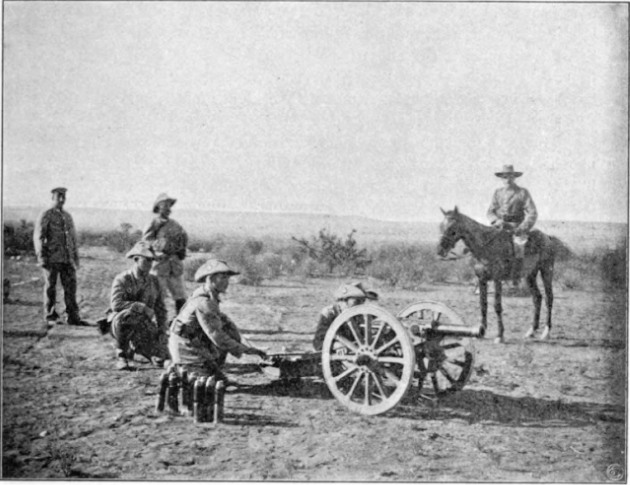
The Schutztruppe had both C73 and C96 feldkanone. The C73 came in two calibers: 7.85 Leichte feldkanone and 8.8 cm Schwere feldkanone. The C96 fired a 7.7cm projectile. At the outset of the Herero war, the Schutztruppe in DSWA had five C73 Leichte feldkanone and was later reenforced with C/96aA and C/96nA field guns from Germany and two feldkanone 91/93 from Kameruun.
The colony also had at least four 5.7 cm quick firing guns or schnellfeurgeschürtzen. Although these saw service during the Herero War as part of Battery 1 under Hauptmann v. Oertzen, I have not been able to locate any good photographs or even details about the design of these weapons.
Four mountain guns were issued to the Schutztruppe and were in service at the outbreak of the German/Herero war. These were 7.2 cm gebirgskanone L/14 M98 and saw hard service between 1904 and 1908 when the colony received the new 7.5 cm gebirgskanone L/17 M08.
Four outdated 10.5 cm fixed recoil field howitzers (feldhaubtize M98 by Rheinmetall) were sent to Southwest Africa during the German/Herero War.
The Seebataillon and Landungskorps from S.M.S. "Habicht" contributed 2 or 3 cone-mounted 3.7 cm Gruson-Hotchkiss revolverkanone and 8 M97 Krupp 3.7cm maschinenkanone.
There were several machine gun sections, served both by marines and sailors and by Schutztruppe.
![]() |
| 7.7cm C96 Feldkanone, Battery 5, 1904 |
![]() |
| Mountain gun emplacement |
![]() |
| Mountain gun battery on mules |
![]() |
| Mountain guns firing |
![]() |
| Sailors with M97 Krupp 3.7cm Maschinenkanone on Darmstadt transport, 1904 |
![]() |
| Schutztruppen with cone mounted 3.7cm Gruson-Hotchkiss revolverkanone from SMS Habicht |
![]() |
| Maxim Gun: Maschinengewehr (probably purchased in 1901) |
Thursday, December 22, 2016
Owikokorero Officer Casualties and Medical Personnel in Bivouac.
I've been looking for an un-watermarked version of this historic image for a long time. It was taken during the German-Herero War in 1904 shortly after the battle of Owikokorero, where an advanced party from Major von Glasnapp's Ostabteilung was ambushed and took very heavy casualties, 10 out of 11 officers in the engagement were hit, with 7 outright fatalities. The Major commandant was lightly wounded in the head, and the other two more seriously wounded officers appear in this image, along with some of the expedition's medical personnel.
Lying in the cot is Oberleuntnant zur See Friedrich Hermann, part of the Landungskorps from S.M.S. "Habicht". He was in charge of a machine gun section and was shot through the left shoulder and also in the left hip. Seated to his right is Marine-Leutnant Theobald Schäfer, who was also adjutant of the Ostabteilung. He was shot through the bone of his left underarm and also in the buttocks.
They are attended by several known medical officers. Standing in the rear at right is Marine-Assistenzartz Dr. Janßen. Seated third from the right is one-year Schutztruppe medical volunteer (Einjährig-freiwilliger) Dr. Ersnt August Kaerger, and seated to his right is Marine-Stabsartz Dr. Wiemann. Following the death at Owikokorero of Marine-Oberassistensartz Dr. Wilhelm Belden of the Landungskorps from S.M.S. "Habicht", these were the three senior medical personnel attached to the Ostabteilung along with a 30 man medical department. Possibly the other Germans in the image were part of that hospital section.
The two native auxiliaries remain unidentified. They could be orderlies or batmen (bambuse) or they could be soldiers serving with the column. They do not appear to be wounded.
Tuesday, November 25, 2014
Images of Seesoldaten from DSWA in 1904
The Marine infantry or Seebataillon companies that arrived in German Southwest Africa in February, 1904 saw heavy service in the months to follow. Those in the 1st Company suffered the most, taking early casualties at Swartklippe and then joining the ill-fated expedition of the Ostabteilung under marine Major von Glasenapp during which they lost dozens of men fighting as the rearguard or nachspitze at Okaharui. The 4th Company also served in the Ostabteilung, while the 3rd was initially with Major Estorff's Westabteilung and fought a hard engagement at Otjihinamaparero and a skirmish near the Omatako Mountains on the way back to Okahandja to where Estorff joined forces with Governor Leutwein's main section or Hauptabteilung. The 2nd Company fought at Klein-Barmen and also joined the Hauptabteilung.
Typhus devastated the 1st and 4th companies, and the remnants of these units along with a detachment from the 3rd company served at Waterburg under Graf von Brockdorff. Members of the Seebataillon's Maschinengewehre Zug under Oberieutenant zur See Wossidlo later garrisoned Fort Namutoni at the very edge of German settlement in the far north of the colony. The Seebataillon also provided medical staff to the German forces.
There are more images of the Seebataillon forces in DSWA than I have located for the sailors in Landungskorps Habicht that I wrote about in the previous post. Most of these are from the 1st or 4th Companies, though there is at least one from the 3rd Company with Estorffs Westabgteilung. In this image at left, the overall commander of the Seebataillon in DSWA, Oberst Dürr can be seen together with his staff and naval officers on board the troop ransport ship en route to the colony.
Marine uniforms can be distinguished from those of the Schutztruppe by their bordtfeld tropenhelms (with or without helmet plates) or the white bands on the visored feldmutz that appear lighter in period photographs than the cornflower blue of the Schutztruppe. Instead of cord shoulder straps in imperial colors, seesoldaten wore detachable white shoulder boards with a gold crown and crossed anchors, but these appear to have been removed while on campaign. There are also differences in NCO insignia.
Sometimes other types of equipment typical of the Seebatallion can be seen in the photographs, such as naval bread bags with belt clips worn by seesoldaten in the Ostabteilung, shown in the image above as marines in the 1st or 4th company cross the ephemeral Black Nossob river. In the image, below, an NCO from the 3rd Seebataillon Company (seated at right, possibly a vice-feldwebel based on his uniform collar and cuff insignia) and a detachment of marines posted near Omaruru prepare a meal while others stand watch.
Below, another group of seesoldaten, this time from the 1st or 4th company, contrives to heat numerous kettles over a single campfire.
The shoulder boards of the marines in the next two images are quite distinct. The senior NCO in the first picture, identified as feldwebel Peters, as indicated by his collar and cuff insignia. They were both taken at Otjosazu near Okahandja. The other pictures show seesoldaten (including a junior and senior NCO), in an open train car, and another marine with a pet zebra. Most of these pictures are made available by the University of Frankfort and are part of its outstanding digital library.
Marines served both machine cannons (maschinenkanonen) and machine guns (machinengewehre) in southwest Africa during 1904. Two machine guns were assigned to a section under Oberleutnant zur See Wossidlo, and dispatched north to Grootfontein in June, 1904 along with Oberleutnant von Zülow's 3rd Schutztruppe Company. Here they met up with the District Commander Oberleutnant Richard D. Volkmann, who featured prominently a series of posts early this year on the Battle of Uitkomst. Wossidlo had previously served with Estorff, and would later deploy his machine guns to help defend the heliograph station which Volkmann ordered Lt. Auer to establish at the top of the Waterberg prior to the battles there in August. In the photograph, below, taken in Grootfontein that June, Wossidlo wears his blue naval officer's coat. From left to right, adults in this image are identified as Oberlt. Böttlin (in charge of the Bastard Abteilung); Lt. Lehman (field artillery); Frau Gathmann; Oberlt. Richard Volkmann; Werner (possibly Oberarzt Dr. Werner); Theodor Gathmann; Frau Kühnehold; Oberlt. z. See Wossidlo; Lt. Freiherr von Reibnitz; Oberlt. von Madai (field artillery) and Oberlt.
v. Zülow.
![]() |
| Seesoldaten with the Ostabteilung traveling in open rail trucks (Photo from database maintained by Goethe Universität Frankfort am Main) |
![]() |
| (Photo from database maintained by Goethe Universität Frankfort am Main) |
Marine uniforms can be distinguished from those of the Schutztruppe by their bordtfeld tropenhelms (with or without helmet plates) or the white bands on the visored feldmutz that appear lighter in period photographs than the cornflower blue of the Schutztruppe. Instead of cord shoulder straps in imperial colors, seesoldaten wore detachable white shoulder boards with a gold crown and crossed anchors, but these appear to have been removed while on campaign. There are also differences in NCO insignia.
![]() |
| Crossing the Black Nossob (Photo from database maintained by Goethe Universität Frankfort am Main) |
![]() |
| Seesoldaten from the 3rd Company (Photo from database maintained by Goethe Universität Frankfort am Main) |
![]() |
| (Photo from database maintained by Goethe Universität Frankfort am Main) |
The shoulder boards of the marines in the next two images are quite distinct. The senior NCO in the first picture, identified as feldwebel Peters, as indicated by his collar and cuff insignia. They were both taken at Otjosazu near Okahandja. The other pictures show seesoldaten (including a junior and senior NCO), in an open train car, and another marine with a pet zebra. Most of these pictures are made available by the University of Frankfort and are part of its outstanding digital library.
![]() |
| (Photo from database maintained by Goethe Universität Frankfort am Main) |
![]() |
| (Photo from database maintained by Goethe Universität Frankfort am Main) |
![]() |
| (Photo from database maintained by Goethe Universität Frankfort am Main) |
![]() |
| (Photo from database maintained by Goethe Universität Frankfort am Main) |
![]() |
| (Photo from database maintained by Goethe Universität Frankfort am Main) |
![]() |
| (Photo from database maintained by Goethe Universität Frankfort am Main) |
Wednesday, June 18, 2014
Lead Pile Status
I've been a tad distracted by significant life events and have not been able to paint up more of my backlog of miniatures for a month or two, but that should change soon. I have a couple dozen Herero foot from various manufacturers (Perry, Askari, Foundry, Northstar) primed and ready to go, and I'm excited to move on to some of the German field artillery, Landungskorps and Seebataillon (and a few more scenics, including some unusual African wildlife).
On the other hand, I now have my very own copy of Dr. Roy Jones and Eric Alvarado's much anticipated Herero War Scenario and Rules Book and have been trying to restrain myself from reading it cover to cover (in case I wish to play any of these myself without knowing the other side's information). It is a labor of love and an outstanding contribution both to this hobby and to the history of the period (some of it only available in English translation through Dr. Jones' good efforts). I am also grateful for the kind mention made of this blog more than once within their book.
The Jones/Alvarado book is based on the venerable The Sword and The Flame rules and expansions by Greenfield Hobby, also no longer in print. Various editions pop up for sale from time to time and as I am unfamiliar with this game system I'm in the market for the 20th edition TSATF rules, or barring that the 1994 3rd edition. I believe the Herero War rules are playable without an edition of TSATF for reference, but for someone just starting out it may prove very useful to have on hand.
I have no pressing deadline by which I need to finish painting up all the figures required for these scenarios, but I would like to start playing them this year and so I may decide to give priority to completing the orbat for some of the smaller encounters so I can take the rules out for a spin. That could mean that some figures, like Herero mounted troops (some of which I still need to acquire in appropriate 28mm scale), will be deferred while others (Herero infiltrators and shock troops, German artillery and sailors) move ahead in the queue.
I've decided that I really like the old German colonial line of figures that sadly are no longer produced by the Honorable Lead Boiler Suit Company for my Schutztruppen, and have been adding them piecemeal to my lead pile whenever I am fortunate to find them available secondhand. Last December I got in an international bidding war on eBay and watched three excellent sets (not especially well painted, each of 6 to 11 figures) slip through my grasp, but I did manage to get in under the wire and purchase 11 of the Schutztruppe figures (all since repainted) for a very steep price. Yesterday I won three unopened packs with 10 of these same figures for half what they originally sold for ($10.50). If I get enough of these, I will paint some as Hereros in captured uniforms.
On the other hand, I now have my very own copy of Dr. Roy Jones and Eric Alvarado's much anticipated Herero War Scenario and Rules Book and have been trying to restrain myself from reading it cover to cover (in case I wish to play any of these myself without knowing the other side's information). It is a labor of love and an outstanding contribution both to this hobby and to the history of the period (some of it only available in English translation through Dr. Jones' good efforts). I am also grateful for the kind mention made of this blog more than once within their book.
The Jones/Alvarado book is based on the venerable The Sword and The Flame rules and expansions by Greenfield Hobby, also no longer in print. Various editions pop up for sale from time to time and as I am unfamiliar with this game system I'm in the market for the 20th edition TSATF rules, or barring that the 1994 3rd edition. I believe the Herero War rules are playable without an edition of TSATF for reference, but for someone just starting out it may prove very useful to have on hand.
I have no pressing deadline by which I need to finish painting up all the figures required for these scenarios, but I would like to start playing them this year and so I may decide to give priority to completing the orbat for some of the smaller encounters so I can take the rules out for a spin. That could mean that some figures, like Herero mounted troops (some of which I still need to acquire in appropriate 28mm scale), will be deferred while others (Herero infiltrators and shock troops, German artillery and sailors) move ahead in the queue.
I've decided that I really like the old German colonial line of figures that sadly are no longer produced by the Honorable Lead Boiler Suit Company for my Schutztruppen, and have been adding them piecemeal to my lead pile whenever I am fortunate to find them available secondhand. Last December I got in an international bidding war on eBay and watched three excellent sets (not especially well painted, each of 6 to 11 figures) slip through my grasp, but I did manage to get in under the wire and purchase 11 of the Schutztruppe figures (all since repainted) for a very steep price. Yesterday I won three unopened packs with 10 of these same figures for half what they originally sold for ($10.50). If I get enough of these, I will paint some as Hereros in captured uniforms.
Wednesday, November 20, 2013
Filling out the Orbat for Jones/Alvaredo Herero War Scenarios
Since Dr. Roy Jones posted the Order of Battle for the upcoming Herero War scenario and rulebook, I've been sizing up my lead pile and examining were I am in good shape, and where I lack enough figures, or even suitable options to represent them, to complete the German and Herero forces. Since posting what I had gathered so far for German Troops and their Allies and their Herero adversaries, I've added some additional figures and equipment, including some from new sources. Nevertheless, the fact remains that I have serious gaps to fill in a number of areas if I want to do every scenario in the book with 25mm / 28mm figures that can represent this period authentically and do it with a minimum of duplication.
Mounted Officers: Jones and Alvaredo call for mounted figures to represent three senior German commanders and two senior Herero commanders. There is very little in the currently available lines of known manufacturers to meet these specifications. The Honourable Lead Boilersuit Company once produced mounted officers for this period but this line has been discontinued. Matchlock Miniatures, which seems to include some of the Falcon Line, makes a mounted officer and it arrived today but regrettably wearing a helmet so perhaps I will need to find him a different head. As for Falcon, I fear that this company may no longer be active, as its website is static and unresponsive and its email is out of service. Perhaps someone who knows the owner can shed further light on the matter. That would be a shame, because it seems that Falcon had German Mounted Command figures in its 25mm German Southwest Africa line that would do nicely.
Quite frankly, I would be willing to settle for mounted officers in slouch hats cocked on the right, or even WWI German officers on horseback wearing field caps. I bit the bullet and spent $25 on the Great Powers High Command set in 25mm from Old Glory's Colonial Boxer Rebellion range. It features six officer figures on horseback, the last of which wears a German Southwester hat. I may be able to paint or convert one or two of the others, but for now can only count on this one, leaving me one more to locate to complete my needs.
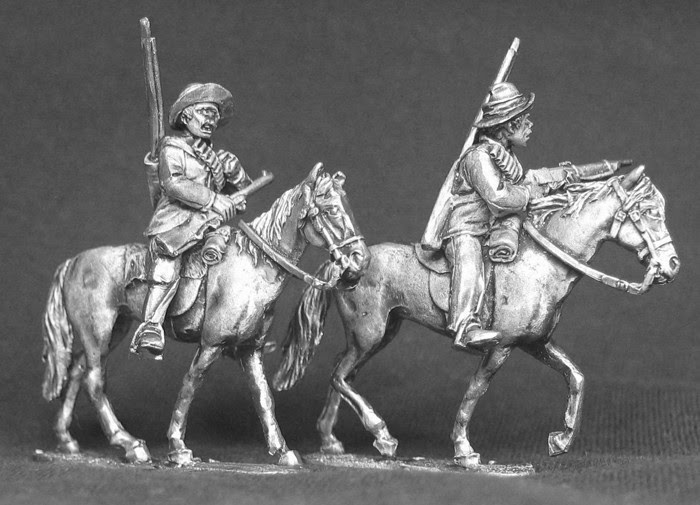
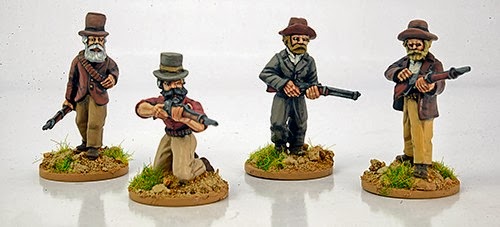
As for the Herero leader a beardless Boer may be the answer (and with all due respect to my progressive minded Afrikaner friends, I appreciate the irony of making an indigenous African out of a Boer). For this figure I could use any from the three figure mounted boer set from Black Tree Design's Boer War range, but I really like the mounted boer officer waving forward from Redoubt, who is painted in such a way on the website that he even looks African. I will probably get several mounted boer figures without beards from both of these companies, and will use the rest as Herero cavalry: (see below). Another option would be to convert the wonderful mounted figure of King Lubengula offered by North Star Africa and adding a wide brimmed hat with epoxy.
Herero Cavalry: I need three full sections (24 figures) of Herero horsemen. Unlike some of the figures on foot who can be wearing loincloths or partial European
clothing, mounted African figures for this period should not be wearing
traditional regalia. This rules out mounted Zulu or Matabele figures
from other ranges. I have one mounted Edendale Native horseman from Redoubt's Zulu range, three Native Horse from Foundry's Zulu range and four Native Horse from Empress' Miniatures Anglo Zulu War figures. These last required removal of the spears in their shoulder quivers but are otherwise excellent and I plan to add another 4 from this range. Still, that would only give me half the horsemen I require, so the rest are likely to be beardless Boers as mentioned above.
Seebataillon gunners: I believe that the Maschinenkanone called for in the Scenario book was served by German marines. There were also marine machine gunners during the war, but I am told they are not included in the Scenario book for playability reasons. The latter can be purchased from Pulp Miniatures, but while there are a number of great options for the Krupp "Pom-Pom gun (37mm Maschinenkanone M97) in this scale, there are no German marines scultpted specifically to serve it. Possibly one or two of the Pulp Figures from the Maxim gun set could do so, but this will require further investigation.
Landungskorps Revolverkanone gunners: I have the cone mounted Hotchkiss gun from HLBS now to represent the ones removed from the SMS "Habitcht" for service with the naval landing party. As I have purchased more Naval machine gun sets than I require from Brigade Games (German) and Redoubt (Austrian), I should be able to borrow from these to serve the revolverkanone.
More Schutztruppe in slouch hats: With Askari, Pulp and Tiger the main options for Schutztruppe that are suitable for this period, and a sprinkling of Brigade Games figures wearing puttees that are not issued in SWA, I am still in need of more Schutztruppe officers and men to complete the foot commanders and eight infantry sections I require. I will certainly need to duplicate sets, and these are likely to be Askaris or Pulp, but whenever I find another option I jump on it.
One such surprising find is from Old Glory in its 25mm Spanish American War range. Here you can get the Spanish "Fantasy" Pack, featuring a German Maxim machine gun crew and adviser. Not only is the two man gun crew a decent alternative to the 2 figure machine gun sections offered by Pulp, but the remaining two figures are officer types and can be used at need to command Schutztruppe infantry.
Herero Shock Troops: Thirty-two are needed. Falcon once made these, I believe wearing captured Seebataillon and/or Schutztruppe uniforms. Alternatives include Brigade Games Schutztruppe in Slouch Hats and Askari's current Herero offering.
Native Auxiliaries: The same figures identified for Herero Shock Troops could be used for these,
but would need to be painted so as to avoid confusion with Herero fighters in German uniforms and I'm not sure an imperial armband or hatband would do that clearly at this scale. I need 24 Witboois and 16 Rehoboth Bastards in sections with one officer and seven men on foot.
My solution for the Bastards is to convert Copplestone's Zanzibar Askaris from its Darkest Africa range by turning their fez headgear into feld hats and giving them shoes fashioned with epoxy putty. This should make them appear very much like the 1905 historic image at right.
As for the Witbooi contingent, I will keep them in civilian clothes with white hats and imperial armbands as well as some braided hat cords, and may well chose to use beardless civilians or Boers for this purpose.
I could use white officers with these native troops, though they had their own Kapteins and Veldkornets as well. Leutnant Müller von Berneck commanded the Witboois in Abteilung Müller during the Hamakari campaign, while Oberleutnant Böttlinhad the Bastards in Major von Estorff's section. While there is no scenario that currently calls for the other group of Native troops that served with the Germans at this time - the Bethany (!Aman) contingent - these were under Lt. Thilo von Trotha at Waterberg and this officer and close relative of the commanding General was later killed during failed negotiations with his former soldiers and allies in 1905 during the Nama war.
Mounted Officers: Jones and Alvaredo call for mounted figures to represent three senior German commanders and two senior Herero commanders. There is very little in the currently available lines of known manufacturers to meet these specifications. The Honourable Lead Boilersuit Company once produced mounted officers for this period but this line has been discontinued. Matchlock Miniatures, which seems to include some of the Falcon Line, makes a mounted officer and it arrived today but regrettably wearing a helmet so perhaps I will need to find him a different head. As for Falcon, I fear that this company may no longer be active, as its website is static and unresponsive and its email is out of service. Perhaps someone who knows the owner can shed further light on the matter. That would be a shame, because it seems that Falcon had German Mounted Command figures in its 25mm German Southwest Africa line that would do nicely.
Quite frankly, I would be willing to settle for mounted officers in slouch hats cocked on the right, or even WWI German officers on horseback wearing field caps. I bit the bullet and spent $25 on the Great Powers High Command set in 25mm from Old Glory's Colonial Boxer Rebellion range. It features six officer figures on horseback, the last of which wears a German Southwester hat. I may be able to paint or convert one or two of the others, but for now can only count on this one, leaving me one more to locate to complete my needs.
![]() |
| Redoubt Enterprises BWBC01 |
| Empress Miniatures ZWB43 |
Seebataillon gunners: I believe that the Maschinenkanone called for in the Scenario book was served by German marines. There were also marine machine gunners during the war, but I am told they are not included in the Scenario book for playability reasons. The latter can be purchased from Pulp Miniatures, but while there are a number of great options for the Krupp "Pom-Pom gun (37mm Maschinenkanone M97) in this scale, there are no German marines scultpted specifically to serve it. Possibly one or two of the Pulp Figures from the Maxim gun set could do so, but this will require further investigation.
Landungskorps Revolverkanone gunners: I have the cone mounted Hotchkiss gun from HLBS now to represent the ones removed from the SMS "Habitcht" for service with the naval landing party. As I have purchased more Naval machine gun sets than I require from Brigade Games (German) and Redoubt (Austrian), I should be able to borrow from these to serve the revolverkanone.
More Schutztruppe in slouch hats: With Askari, Pulp and Tiger the main options for Schutztruppe that are suitable for this period, and a sprinkling of Brigade Games figures wearing puttees that are not issued in SWA, I am still in need of more Schutztruppe officers and men to complete the foot commanders and eight infantry sections I require. I will certainly need to duplicate sets, and these are likely to be Askaris or Pulp, but whenever I find another option I jump on it.
One such surprising find is from Old Glory in its 25mm Spanish American War range. Here you can get the Spanish "Fantasy" Pack, featuring a German Maxim machine gun crew and adviser. Not only is the two man gun crew a decent alternative to the 2 figure machine gun sections offered by Pulp, but the remaining two figures are officer types and can be used at need to command Schutztruppe infantry.
Herero Shock Troops: Thirty-two are needed. Falcon once made these, I believe wearing captured Seebataillon and/or Schutztruppe uniforms. Alternatives include Brigade Games Schutztruppe in Slouch Hats and Askari's current Herero offering.
Native Auxiliaries: The same figures identified for Herero Shock Troops could be used for these,
![]() |
| Courtesy of German Colonial Uniforms Website |
My solution for the Bastards is to convert Copplestone's Zanzibar Askaris from its Darkest Africa range by turning their fez headgear into feld hats and giving them shoes fashioned with epoxy putty. This should make them appear very much like the 1905 historic image at right.
As for the Witbooi contingent, I will keep them in civilian clothes with white hats and imperial armbands as well as some braided hat cords, and may well chose to use beardless civilians or Boers for this purpose.
I could use white officers with these native troops, though they had their own Kapteins and Veldkornets as well. Leutnant Müller von Berneck commanded the Witboois in Abteilung Müller during the Hamakari campaign, while Oberleutnant Böttlinhad the Bastards in Major von Estorff's section. While there is no scenario that currently calls for the other group of Native troops that served with the Germans at this time - the Bethany (!Aman) contingent - these were under Lt. Thilo von Trotha at Waterberg and this officer and close relative of the commanding General was later killed during failed negotiations with his former soldiers and allies in 1905 during the Nama war.
Labels:
25/28mm Figures,
Black Tree,
Falcon/Matchlock,
Herero Forces,
HLBS,
Landsungskorps,
Mounted Command Figures,
Mounted Troops,
Old Glory,
Order of Battle,
Redoubt,
Rules,
Schutztruppe,
Seebataillon
Sunday, November 17, 2013
Three HLBS Company Germans in a Batch I Won on eBay
I feel rather pleased about these figures, which I picked up on Ebay this afternoon. I will repaint them when they arrive (from Thailand, so I hope they make it). The three figures in Südwester hats and riding boots are from the discontinued Honourable Lead Boilersuit Company's 28mm German Colonial line and I was specifically after these when I bid on this mixed assortment. The others include three of the four poses offered by Brigade Games Great War in Africa series for Schutztruppe in slouch hats, two of the German marines produced by Copplestone Castings, and two Copplestone Zanzibari regulars that I will convert (by giving them shoes and feld caps) to Native auxiliaries from the Rehoboth Bastard contingent. All in all, I am very happy to have them on the way.
Friday, November 15, 2013
Another Good Option for 25mm Seebataillon and Landungskorps in SWA
The Order of Battle for the war games in the upcoming Herero War scenario and reference book by Jones and Alvarado calls for a fair number of German marines and an even larger number of sailors for the Landungskorps. I have the fine sets of the former from Copplestone and plan to add more from Pulp, but using these I will be stretched to provide the 36 figures needed to fill out 4 Marine sections (1 officer plus 7 marines in each), a senior commander, plus a 3 figure machine gun section. It can be done in 28mm without repeat purchases, but barely.
It is even more challenging filling out the sailors in the Landungskorps, for that will require 2 senior officers and a senior NCO (all on foot), six artillery figures with a machine gun and a revolver cannon, and 8 Landungskorps Units (1 Officer, 7 Sailors in each). This comes to 73 sailors and a large number of officers/NCOs, and while Brigade Games Great War in Africa series sets the standard and offers many of the figures this will require, it means purchasing multiple sets and a lot of duplication in the officer figures. Short of some careful surgery to swap heads and arms, this does not allow for much variation in sailor sculpts.
Luckily, there is another excellent option that will add 8-10 German marine figures, two 3 figure
sailor gun crews with at least one usable machine gun, and a handful of sailors for the Landungskorps. All are in suitable uniforms, and all come in 25mm from Redoubt's Boxer Rebellion range. They are offered as single figures or gun crew sets. The German marines are from Seebataillon III and are fully compatible with their sister bataillons that were dispatched to Southwest Africa. The sailors are from Germany's strong ally Austria Hungary, and work well with those from Brigade Games. I plan to use some of them to crew my revolver cannon, probably the crew shown above with a Skoda machine gun.
It is even more challenging filling out the sailors in the Landungskorps, for that will require 2 senior officers and a senior NCO (all on foot), six artillery figures with a machine gun and a revolver cannon, and 8 Landungskorps Units (1 Officer, 7 Sailors in each). This comes to 73 sailors and a large number of officers/NCOs, and while Brigade Games Great War in Africa series sets the standard and offers many of the figures this will require, it means purchasing multiple sets and a lot of duplication in the officer figures. Short of some careful surgery to swap heads and arms, this does not allow for much variation in sailor sculpts.
Luckily, there is another excellent option that will add 8-10 German marine figures, two 3 figure
sailor gun crews with at least one usable machine gun, and a handful of sailors for the Landungskorps. All are in suitable uniforms, and all come in 25mm from Redoubt's Boxer Rebellion range. They are offered as single figures or gun crew sets. The German marines are from Seebataillon III and are fully compatible with their sister bataillons that were dispatched to Southwest Africa. The sailors are from Germany's strong ally Austria Hungary, and work well with those from Brigade Games. I plan to use some of them to crew my revolver cannon, probably the crew shown above with a Skoda machine gun.
Wednesday, October 30, 2013
Archival Images
In researching the German = Herero War of 1904, I sometime come across period images of those involved in this conflict that are not commonly found elsewhere on the web. I do not have the provenance for the image of the horseman, at right. This rider of the Schutztruppe is an outstanding portrait, clearly showing his Schutztruppe saddlebag and the carbine housed in its leather pouch in front of the right leg. He wears the standard harness with its ammunition pouches, and what looks like the 1896 khaki tropical uniform. I dearly wish a manufacturer in 25 mm / 28mm would produce properly accoutered mounted Shutztruppen, in kord uniforms as well as khaki.
The image at left comes from Aus der Geschichte der Schutztruppe für
Südwestafrika, a German account by Alexander Cormans published in 1914. It shows the German District Officer for Gibeon, Karl Henning Conrad von. Burgsdorff, who was killed in October, 1904 at the outbreak of hostilities with the Nama. He is accompanied by several native auxiliaries, almost certainly from the Nama, as the individual in the striped coat also appears in another image with von Burgsdorff and is identified as the Fransman Nama Kaptein Simon Kooper. The other man seated to the left of him is wearing the imperial colored armband signifying his allied status. This image illustrates the range of fabrics and shades of color that can be used for European civilian clothing worn by the Nama during this period.
Another image from Cormans' book depicts the Seebataillon at Omaruru, presumably the 3rd Marine
Infantry Company that was part of Major Estorff's West Section that operated in this sector during the latter part of February, 1904. Estorff's men fought a 10-hour engagement at Otjihihamaparerero before rejoining the Main Section under Governor Leutwein and participating in the aborted campaign that included fighting at Ongandjira and Owiumbo. The marine at right wears an NCO's braid on his uniform collar, and his boots are a decidedly lighter color than his black marine ammunition harness.
It is hard to tell whether the marine emblems have been removed from their cork sun helmets, but the cloth covering appears to be a light khaki, or perhaps it was stained a darker color. There is documentation in an account by Obermatrosen G. Auer that he and his fellow sailors in the landungskorps from the S.M.S. "Habicht" dyed their tropical white uniforms with coffee and tobacco.
The traditional Herero village homestead or "werft" included domed, round houses with low entries, walls that had been daubed with mud and cow manure, and a thatched roof covering. The image at left shows one such "pontok" below the Waterberg. I am looking forward to modelling scenic elements for my German = Herero War gaming table, and huts like these will certainly be among them.
The image at left comes from Aus der Geschichte der Schutztruppe für
Südwestafrika, a German account by Alexander Cormans published in 1914. It shows the German District Officer for Gibeon, Karl Henning Conrad von. Burgsdorff, who was killed in October, 1904 at the outbreak of hostilities with the Nama. He is accompanied by several native auxiliaries, almost certainly from the Nama, as the individual in the striped coat also appears in another image with von Burgsdorff and is identified as the Fransman Nama Kaptein Simon Kooper. The other man seated to the left of him is wearing the imperial colored armband signifying his allied status. This image illustrates the range of fabrics and shades of color that can be used for European civilian clothing worn by the Nama during this period.Another image from Cormans' book depicts the Seebataillon at Omaruru, presumably the 3rd Marine
Infantry Company that was part of Major Estorff's West Section that operated in this sector during the latter part of February, 1904. Estorff's men fought a 10-hour engagement at Otjihihamaparerero before rejoining the Main Section under Governor Leutwein and participating in the aborted campaign that included fighting at Ongandjira and Owiumbo. The marine at right wears an NCO's braid on his uniform collar, and his boots are a decidedly lighter color than his black marine ammunition harness. It is hard to tell whether the marine emblems have been removed from their cork sun helmets, but the cloth covering appears to be a light khaki, or perhaps it was stained a darker color. There is documentation in an account by Obermatrosen G. Auer that he and his fellow sailors in the landungskorps from the S.M.S. "Habicht" dyed their tropical white uniforms with coffee and tobacco.
The traditional Herero village homestead or "werft" included domed, round houses with low entries, walls that had been daubed with mud and cow manure, and a thatched roof covering. The image at left shows one such "pontok" below the Waterberg. I am looking forward to modelling scenic elements for my German = Herero War gaming table, and huts like these will certainly be among them.Thursday, October 24, 2013
25mm / 28mm Scale Choices for Herero War Seebataillon, Landungskorp, Native Auxilleries and Civilians
In addition to the Schutztruppe - both the "old Africans" and their hastily assembled reinforcements - the German Colonial forces in the Herero war included marine and naval troops, along with native auxiliaries, armed settlers and non-combatant teamsters. This post examines figure options available to tabletop wargamers for this conflict in 25mm / 28mm scales.
As mentioned in a prior post, among the very first reinforcements to come ashore at Swakopmund
were a landing party of sailors from the gunboat "Habitcht", followed shortly thereafter by Marine-Infanterie-Kompagnien made up of detachments from four Imperial "Seebataillon" units, along with machine gun sections that appear to have been served by elements of each of these branches of service.
The best choice for figures representing the German landing party is those offered by Brigade Games from their Great War in Africa line. These sailors in tropical dress are 28mm figures include a 4 figure command set, two 8 figure sets in 4 poses each, and a 3 figure heavy machine gun Maxim team. With 23 figures you have nearly half the total force of the initial landing party and may not be able to bring them all into play in most gaming scenarios, but you will be able to put forward an excellent showing of these Imperial sailors.
For Seesoldaten, there are two good possibilities. Mark Copplestone's Copplestone Castings has a Darkest Africa line that includes German marines advancing at port. There is also a marine officer included in Copplestone's German officers pack, as well as another officer in a field cap who would paint up well for the Schutztruppe (the other three are of less value for a Herero War scenario, with two in fez and one in a non military pith helmet). I have both sets and intend to paint the marine officer to stand in for Major von Glasenapp, the overall commander of the Marine-Infanterie in Southwest Africa who fought with the Eastern section of the Colonial forces at Owikokorero and Okaharui.
The other choice is to go with Pulp Figures. I have several of their colonial troop sets in slouch
hats, as well as their seebataillon set in field caps which I am intending to paint as Schutztruppe because primary sources indicate they were issued sun helmets for Southwest Africa service. The other Seebataillon from Pulp Miniatures include a four figure Maxim gun crew with officer that I intend to purchase. They also offer a five figure Seebataillon officer set, an NCO set and a set of troops in sun helmets. The later is dynamic and looks fun to paint, but I am not sure how they will look alongside the slimmer Copplestone figures. As for the others, there is something a bit to cartoonish in the officer set for my taste, but I might get the NCO set if the Seesoldaten in sun helmets end up working for my layout.
There were no Askaris in Southwest Africa, and no African Auxiliaries in fez. The Germans had three units of native allies in the Herero war. The Wilbooi Nama sent about 80 men, mostly distinguished by armbands in Imperial colors. Any of the limited options for mounted Hereros discussed in a prior article could serve for Witbooi Nama if armbands were added and their hats painted to appear to be covered in white cloth, with or without Imperial colored hat bands. There were also Bethany Nama, though I can find very little about them except that the nephew of the overall commander von Trotha may have commanded them in the Waterberg campaign. At need, either Nama group could be represented by Brigade Games Schutztruppe Askaris in slouch hats, distinguished by painting armbands, handbands and hat covers as described above .As for the Rehoboth "Basters", it would take some significant conversion to make a uniformed unit of these troops and I have not seen suitable figures on the market that would work for them.
There were both German and Boer settlers who fought the Herero during 1904. The former were
largely reservists in Schutztruppe uniforms. As for the Boer, there are any number of manufacturers who offer both mounted and dismounted figures for South African boers as the appears between 1879 and 1902. I am partial to Wargames Foundry Miniatures' sets from their Boer War range (DA-18/7 and 18/8), but also like those provided by Empress Miniatures for their Anglo-Zulu War Line and by North Star Africa.
North Star also offers a boer wagon driver and native voorloper as teamsters for several authentic Boer wagons provided as laser cut wooden models by 4Ground, along with the oxen needed to pull them. As the heavy sands of the Southwest African veld often required 18-20 oxen for a single wagon, you will want more than a two ox team to give the right impression. I have at six on a jawbone wagon at the moment and may add two more.
As mentioned in a prior post, among the very first reinforcements to come ashore at Swakopmund
![]() |
| Brigade Games BG-WIAG17 German Sailor Command |
The best choice for figures representing the German landing party is those offered by Brigade Games from their Great War in Africa line. These sailors in tropical dress are 28mm figures include a 4 figure command set, two 8 figure sets in 4 poses each, and a 3 figure heavy machine gun Maxim team. With 23 figures you have nearly half the total force of the initial landing party and may not be able to bring them all into play in most gaming scenarios, but you will be able to put forward an excellent showing of these Imperial sailors.
![]() |
| Copplestone Castings AFU-1 German Marines |
The other choice is to go with Pulp Figures. I have several of their colonial troop sets in slouch
| Pulp Figures PGS-2 German Seebataillon NCOs |
hats, as well as their seebataillon set in field caps which I am intending to paint as Schutztruppe because primary sources indicate they were issued sun helmets for Southwest Africa service. The other Seebataillon from Pulp Miniatures include a four figure Maxim gun crew with officer that I intend to purchase. They also offer a five figure Seebataillon officer set, an NCO set and a set of troops in sun helmets. The later is dynamic and looks fun to paint, but I am not sure how they will look alongside the slimmer Copplestone figures. As for the others, there is something a bit to cartoonish in the officer set for my taste, but I might get the NCO set if the Seesoldaten in sun helmets end up working for my layout.
There were no Askaris in Southwest Africa, and no African Auxiliaries in fez. The Germans had three units of native allies in the Herero war. The Wilbooi Nama sent about 80 men, mostly distinguished by armbands in Imperial colors. Any of the limited options for mounted Hereros discussed in a prior article could serve for Witbooi Nama if armbands were added and their hats painted to appear to be covered in white cloth, with or without Imperial colored hat bands. There were also Bethany Nama, though I can find very little about them except that the nephew of the overall commander von Trotha may have commanded them in the Waterberg campaign. At need, either Nama group could be represented by Brigade Games Schutztruppe Askaris in slouch hats, distinguished by painting armbands, handbands and hat covers as described above .As for the Rehoboth "Basters", it would take some significant conversion to make a uniformed unit of these troops and I have not seen suitable figures on the market that would work for them.
There were both German and Boer settlers who fought the Herero during 1904. The former were
![]() |
| North Star Africa NSA6001 - Boer Riflemen I |
North Star also offers a boer wagon driver and native voorloper as teamsters for several authentic Boer wagons provided as laser cut wooden models by 4Ground, along with the oxen needed to pull them. As the heavy sands of the Southwest African veld often required 18-20 oxen for a single wagon, you will want more than a two ox team to give the right impression. I have at six on a jawbone wagon at the moment and may add two more.
Wednesday, October 16, 2013
Types of Troops Serving with the German Colonial Forces in the Herero War of 1904
When the first shots of the Herero War were fired at Okahandja in January of 1904, the German colonial Schutztruppe in Southwest Africa consisted of 500 men in four of Feldkompagnien of mounted infantry and an artillery company, along with another 266 police and administrative personnel. There were an additional 766 trained reserves, many of whom were former soldiers who had settled in the Colony. Detachments of the Schutztruppe were widely dispersed at isolated posts, and many were deployed in action far to the south against the Bondalswart Nama.
According to the outstanding Namibian Chronology compiled online by the late Klaus Dierks;
"In the first
couple of days 123 Germans are killed (among them 13 active soldiers, seven Boers and five
women), goods and cattle are stolen, and infrastructures, buildings and properties are
destroyed, mainly between Okahandja and Omaruru."
The first available reinforcements were a naval detachment sent ashore at Swakopmund on January 18th from the German kanonenboot SMS "Habicht". This consisted of a 55-man landing party or "landungskorps" of armed sailors under the command of the first officer, Kapitänleutnant Hans Gygas.
More reinforcements arrived in Swakopmund on February 9th. These were German marines or seesoldaten in a Marine-Expeditionskorps comprised of detachments from the I and III Seebataillons under the command of Major Georg Franz von Glasenapp. It also included 8 machine gun teams with a mix of naval and marine gun teams to serve them There was one marine-operated maschinekanone , for example, engaged at the Battle of Otijinamaparero.
A Schutztruppe reinforcement was authorized as soon as hostilities broke out and these began arriving in February. 1,576 officers and men had landed by the end of March, along with 1,000 horses, 10 artillery pieces and 6 machine guns. These fresh troops wore the Schutztruppe uniform though some had only volunteered for a single year's service.
German reservists living in Southwest Africa were called to service during the Herero War. They were usually issued Shutztruppe uniforms (though these may in some cases have been older models) and had solid Schutztruppe training. A number of boers also living in the colony fought with the Germans, notably against the Nama later that year at the Battle of Kub.The Germans did not have uniformed native askaris in the Southwest Africa Schutztruppe. There
were several hundred native auxiliaries, however, who served with them against the Herero in 1904. These included Namas under Henrick Witbooi ,who fought their traditional enemies the Hereros but who subsequently took up arms against the Germans when they saw their own end presaged by the extermination campaign against the Herero. They also included a group of mixed race Rehoboth "Basters" who had emigrated to the territory from South Africa and signed a protection treaty with the Germans in the 1880s. At the battle of Hamakari, a third
group of mounted Native Auxiliaries from the Bethanie Nama served in Oberst Deimling's
section under Leuntant Thilo Von Trotha, nephew of the overall
commander.
These tribal-auxillery troops served as scouts and fought as dismounted infantry. They either wore their own European clothing with imperial colors armbands on their left arms or as a strip around the hatband, or had Schutztruppe uniforms with the silver braid removed from any blue cuffs and collars.
By April, 1904, there were perhaps 2,500 German effectives able to take the field, organized in three detachments (East, West and Main). These units were dramatically expanded in June with the arrival of more than 10,000 reinforcements and a new overall field commander, Lieutenant General Adrian Dietrich Lothar von Trotha.
German Forces peaked during the Herero-Nama wars at an astounding 20,000 men, and were ultimately reduced after hostilities ended in 1907 to 4,000. During these conflicts between January, 1904 and June 1906, they suffered 2,466 casualties, including 916 deaths in battle, from wounds or accidents, or missing and presumed dead; 898 wounded, 652 died of disease. Estimates of Herero, Nama, Damara and other indigenous losses during this same period approach 100,000 dead.
According to the outstanding Namibian Chronology compiled online by the late Klaus Dierks;
"In the first
couple of days 123 Germans are killed (among them 13 active soldiers, seven Boers and five
women), goods and cattle are stolen, and infrastructures, buildings and properties are
destroyed, mainly between Okahandja and Omaruru."The first available reinforcements were a naval detachment sent ashore at Swakopmund on January 18th from the German kanonenboot SMS "Habicht". This consisted of a 55-man landing party or "landungskorps" of armed sailors under the command of the first officer, Kapitänleutnant Hans Gygas.
More reinforcements arrived in Swakopmund on February 9th. These were German marines or seesoldaten in a Marine-Expeditionskorps comprised of detachments from the I and III Seebataillons under the command of Major Georg Franz von Glasenapp. It also included 8 machine gun teams with a mix of naval and marine gun teams to serve them There was one marine-operated maschinekanone , for example, engaged at the Battle of Otijinamaparero.
A Schutztruppe reinforcement was authorized as soon as hostilities broke out and these began arriving in February. 1,576 officers and men had landed by the end of March, along with 1,000 horses, 10 artillery pieces and 6 machine guns. These fresh troops wore the Schutztruppe uniform though some had only volunteered for a single year's service.
German reservists living in Southwest Africa were called to service during the Herero War. They were usually issued Shutztruppe uniforms (though these may in some cases have been older models) and had solid Schutztruppe training. A number of boers also living in the colony fought with the Germans, notably against the Nama later that year at the Battle of Kub.The Germans did not have uniformed native askaris in the Southwest Africa Schutztruppe. There
were several hundred native auxiliaries, however, who served with them against the Herero in 1904. These included Namas under Henrick Witbooi ,who fought their traditional enemies the Hereros but who subsequently took up arms against the Germans when they saw their own end presaged by the extermination campaign against the Herero. They also included a group of mixed race Rehoboth "Basters" who had emigrated to the territory from South Africa and signed a protection treaty with the Germans in the 1880s. At the battle of Hamakari, a third
group of mounted Native Auxiliaries from the Bethanie Nama served in Oberst Deimling's
section under Leuntant Thilo Von Trotha, nephew of the overall
commander. These tribal-auxillery troops served as scouts and fought as dismounted infantry. They either wore their own European clothing with imperial colors armbands on their left arms or as a strip around the hatband, or had Schutztruppe uniforms with the silver braid removed from any blue cuffs and collars.
By April, 1904, there were perhaps 2,500 German effectives able to take the field, organized in three detachments (East, West and Main). These units were dramatically expanded in June with the arrival of more than 10,000 reinforcements and a new overall field commander, Lieutenant General Adrian Dietrich Lothar von Trotha.
German Forces peaked during the Herero-Nama wars at an astounding 20,000 men, and were ultimately reduced after hostilities ended in 1907 to 4,000. During these conflicts between January, 1904 and June 1906, they suffered 2,466 casualties, including 916 deaths in battle, from wounds or accidents, or missing and presumed dead; 898 wounded, 652 died of disease. Estimates of Herero, Nama, Damara and other indigenous losses during this same period approach 100,000 dead.
Subscribe to:
Posts (Atom)