Showing posts with label Images of German Officers. Show all posts

Thursday, August 10, 2017

Doctors and Nurses at the Marine-Feldlazarett in Okahandja, 1904


Here is an image from 1904 of German medical personnel at the Marine-Feldlazarett in Okahandja, Southwest Africa.  The identities of all six individuals are known.

Seated in the center is Dr. Gappel, Marine-Stabsartz and Chefartz of the Marine-Expeditionskorps. He was based at Helgoland before shipping out for Africa  in late January, 1904 on board the S.S. Darmstadt.  Initially based with the 2nd Marine-Kompagnie at Okahandja, he established the Marine base hospital here, which is also where this photograph was taken.  He returned to Germany at the end of September, 1904.

Seated in the front row are "Sister" Lili Hartoy (at left) and "Sister" Helene Doll (at right).  I wish I knew more about these nurses.  In the end of march and beginning of April, reinforcements started to embark for Southwest Africa that included "62 hospital nurses and bakers".  Perhaps these two women were among this group.  It could also be that they were members of the German "Womens' League*" which sent an initial seven "sisters" to nurse the sick in the Colony in January and February, followed by another twenty.  It is unclear whether there were any female nurses with the Marine- Expeditionskorps or whether some of these Women's League nurses may have been assigned to it. The main feldlazarett at Okahandja would have been  a logical place for some of them to be posted.

Standing at left is Marine-Assistenzartz Dr. Brüggmann, who was assigned to the Schutztruppe on January 27, 1904.  Next to him is Oberassistenzartz Dr. Janßen, who sailed on Darmstadt with Dr. Gappel and was assigned from the Ostsee station. He served with the Ostabteilung in March and April, 1904, returning to Germany in the Spring of 1905.   Standing at right is Lazarett-Inspektor Brück, about whom I have learned nothing further.

* Possibly the German-National Women's League


Thursday, December 22, 2016

Owikokorero Officer Casualties and Medical Personnel in Bivouac.


I've been looking for an un-watermarked version of this historic image for a long time.  It was taken during the German-Herero War in 1904 shortly after the battle of Owikokorero, where an advanced party from Major von Glasnapp's Ostabteilung was ambushed and took very heavy casualties,   10 out of 11 officers in the engagement were hit, with 7 outright fatalities.  The Major commandant was lightly wounded in the head, and the other two more seriously wounded officers appear in this image, along with some of the expedition's medical personnel.

Lying in the cot is Oberleuntnant zur See Friedrich Hermann, part of the Landungskorps from S.M.S. "Habicht".  He was in charge of a machine gun section and was shot through the left shoulder and also in the left hip.  Seated to his right is Marine-Leutnant Theobald Schäfer, who was also adjutant of the Ostabteilung.  He was shot through the bone of his left underarm and also in the buttocks.

They are attended by several known medical officers.  Standing in the rear at right is Marine-Assistenzartz Dr. Janßen.  Seated third from the right is one-year Schutztruppe medical volunteer (Einjährig-freiwilliger) Dr. Ersnt August Kaerger, and seated to his right is Marine-Stabsartz Dr. Wiemann.  Following the death at Owikokorero of Marine-Oberassistensartz Dr. Wilhelm Belden of the Landungskorps from S.M.S. "Habicht", these were the three senior medical personnel attached to the Ostabteilung along with a 30 man medical department.  Possibly the other Germans in the image were part of that hospital section.

The two native auxiliaries remain unidentified.  They could be orderlies or batmen (bambuse) or they could be soldiers serving with the column.  They do not appear to be wounded.


Tuesday, November 25, 2014

Images of Seesoldaten from DSWA in 1904

The Marine infantry or Seebataillon companies that arrived in German Southwest Africa in February, 1904 saw heavy service in the months to follow.  Those in the 1st Company suffered the most, taking early casualties at Swartklippe and then joining the ill-fated expedition of the Ostabteilung under marine Major von Glasenapp during which they lost dozens of men fighting as the rearguard or nachspitze at Okaharui.  The 4th Company also served in the Ostabteilung, while the 3rd was initially with Major Estorff's Westabteilung and fought a hard engagement at Otjihinamaparero and a skirmish near the Omatako Mountains on the way back to Okahandja to where Estorff joined forces with Governor Leutwein's main section or Hauptabteilung. The 2nd Company fought at Klein-Barmen and also joined the Hauptabteilung.  

Seesoldaten with the Ostabteilung traveling in open rail trucks
(Photo from database maintained by Goethe Universität Frankfort am Main)
Typhus devastated the 1st and 4th companies, and the remnants of these units along with a detachment from the 3rd company served at Waterburg under Graf von Brockdorff.  Members of the Seebataillon's Maschinengewehre Zug under Oberieutenant zur See Wossidlo later garrisoned Fort Namutoni at the very edge of German settlement in the far north of the colony.  The Seebataillon also provided medical staff to the German forces.

(Photo from database maintained by Goethe Universität Frankfort am Main)
There are more images of the Seebataillon forces in DSWA than I have located for the sailors in Landungskorps Habicht that I wrote about in the previous post.  Most of these are from the 1st or 4th Companies, though there is at least one from the 3rd Company with Estorffs Westabgteilung.  In this image at left, the overall commander of the Seebataillon in DSWA, Oberst Dürr can be seen together with his staff and naval officers on board the troop ransport ship en route to the colony.

Marine uniforms can be distinguished from those of the Schutztruppe by their bordtfeld tropenhelms (with or without helmet plates) or the white bands on the visored feldmutz that appear lighter in period photographs than the cornflower blue of the Schutztruppe.  Instead of cord shoulder straps in imperial colors, seesoldaten wore detachable white shoulder boards with a gold crown and crossed anchors, but these appear to have been removed while on campaign. There are also differences in NCO insignia.

Crossing the Black Nossob
(Photo from database maintained by Goethe Universität Frankfort am Main)
Sometimes other types of equipment typical of the Seebatallion can be seen in the photographs, such as naval bread bags with belt clips worn by seesoldaten in the Ostabteilung, shown in the image above as marines in the 1st or 4th company cross the ephemeral Black Nossob river. In the image, below, an NCO from the 3rd Seebataillon Company (seated at right, possibly a vice-feldwebel based on his uniform collar and cuff insignia) and a detachment of marines posted near Omaruru prepare a meal while others stand watch.

Seesoldaten from the 3rd Company
(Photo from database maintained by Goethe Universität Frankfort am Main)
Below, another group of seesoldaten, this time from the 1st or 4th company,  contrives to heat numerous kettles over a single campfire.

(Photo from database maintained by Goethe Universität Frankfort am Main)


The shoulder boards of the marines in the next two images are quite distinct.  The senior NCO in the first picture, identified as feldwebel Peters, as indicated by his collar and cuff insignia.  They were both taken at Otjosazu near Okahandja. The other pictures show seesoldaten (including a junior and senior NCO), in an open train car, and another marine with a pet zebra.  Most of these pictures are made available by the University of Frankfort and are part of its outstanding digital library.

(Photo from database maintained by Goethe Universität Frankfort am Main)

(Photo from database maintained by Goethe Universität Frankfort am Main)

(Photo from database maintained by Goethe Universität Frankfort am Main)
Marines served both machine cannons (maschinenkanonen) and machine guns (machinengewehre) in southwest Africa during 1904.  Two machine guns were assigned to a section under Oberleutnant zur See Wossidlo, and dispatched north to Grootfontein in June, 1904 along with Oberleutnant von Zülow's 3rd Schutztruppe Company.  Here they met up with the District Commander Oberleutnant Richard D. Volkmann, who featured prominently a series of posts early this year on the Battle of Uitkomst.  Wossidlo had previously served with Estorff, and would later deploy his machine guns to  help defend the heliograph station which Volkmann ordered Lt. Auer to establish at the top of the Waterberg prior to the battles there in August.  In the photograph, below, taken in Grootfontein that June, Wossidlo wears his blue naval officer's coat.  From left to right, adults in this image are identified as Oberlt. Böttlin (in charge of the Bastard Abteilung); Lt. Lehman (field artillery); Frau Gathmann; Oberlt. Richard Volkmann; Werner (possibly Oberarzt Dr. Werner); Theodor Gathmann; Frau Kühnehold; Oberlt. z. See Wossidlo; Lt. Freiherr von Reibnitz; Oberlt. von Madai (field artillery) and Oberlt. v. Zülow.

(Photo from database maintained by Goethe Universität Frankfort am Main)

Sunday, November 23, 2014

Images of the Landsungskorps from S.M.S. "Habicht" in DSWA in 1904

A detachment of sailors from SMS "Habicht" was the first reenforcement to arrive in German Southwest Africa at the outbreak of the 1904 war with the Herero.   Landungskorps "Habitcht" guarded railway stations along the narrow gauge line between Swakopmund and Okahandja and fought several sharp actions at Liewenberg at Groß-Barmen.  Sailors from "Habicht" helped serve in a Machinenkanonen section with Ludwig von Estorff's Westabteilung.  Dr. Belden and two sailors from "Habicht" were killed, and Oberleutnant zur See Friedrich Hermann, was wounded at Owikokorero with the Ostabteilung. Several more died of typhus.

Several sailors visible, in both blue and white uniforms, 2 with the 1902 Bordtfeld Tropenhelm
(Photo from database maintained by Goethe Universität Frankfort am Main)


Images of sailors from Landungskorps "Habicht" are few and far between.  Those that I have been able to discover show a mix of uniforms (the white Arbeitsbluse, winter blues and perhaps even work shirts stained khaki with a dye of coffee and tobacco) and head wear (naval caps, Bordtfeld tropenhelms and even a Sudwester or two).  If there is a unifying feature it is the blue, removable naval collar, with or without a black neckerchief , and an open, V necked blouse.

Here is an image of Waldau station on the railway line a few kilometers west of Okahandja before the war began, followed by one after it had been burned and was reoccupied and fortified by Schutztruppen and sailors from the Landungskorps.  You can see two sailors in the second image, one in a Sudwester hat, and the corrugated sheet metal used to make the burned out station defensible.

Waldau Station, 1903
(Photo from database maintained by Goethe Universität Frankfort am Main)


Many of the sailors in the Landungskorps served automatic artillery pieces, including machine cannon (maschinenkanonen), revolver cannons (revolverkanonen) and machine guns (maschinenegewehre).  The following image from Okasise station on the railway line on June 30, 1904 includes a revolverkanone crew and gun platform, and includes a significant number of sailors from the Landungskorps (and one or more officers).

(Photo from database maintained by Goethe Universität Frankfort am Main)


A close up of the gun crew in this photograph (from the digital library of Goethe Universität, Frankfort am Main, which has a wealth of period images), reveals soldiers in their winter blues - appropriate for this time of year in the southern Hemisphere - and summer whites or work blouses.  The officer in front strikes a jaunty pose.

Small detachments of Sailors from the Landungskorps also served machine guns and other automatic cannons with Estorff's Westabteilung at Omaruru and with Glasenapp's Ostabteilung.  One of the former is shown, below, at the grave of  Leutnant Erich Georg Kuno Freiherr von Woellwarth-Lauterburg who died of wounds received during the siege of Omaruru on February 14th, 1904.

(Photo from database maintained by Goethe Universität Frankfort am Main)

Another sailor stands at a pair of graves, unfortunately just too pixelated for me to determine their names, in the image below. His collar is darker than his blouse but the shirt is no longer white.  It may be an example of one of the sailor uniforms that was stained khaki with coffee and tobacco.  It is just possible that the same sailor, in different clothing, appears in this photograph as the one above.  Hard to tell, but there is a resemblance...

(Photo from database maintained by Goethe Universität Frankfort am Main)

Tuesday, September 9, 2014

Twas the Weihnachten before Uitkomst: What a Forgotten Photograph May Reveal (The Battle of Uitkomst Part IX)

Photo by Paul Rohrbach in his "Drei afrikanische Weihnachten" published in St. Niclas, Illustrierte Deutsche, Eine Deutsche Weihnachtsgabe 1912, pg 48.
Paul Rohrbach, the Settlement Commissioner for German Southwest Africa, happened to be touring the Grootfontein District in the weeks leading up to the outbreak of hostilities with the Herero.  His diary and several of his other written accounts have been indispensable to my research on Battle of Uitkomst, in which he served as a war volunteer.  Rohrbach was a prolific writer who possessed great enthusiasm for the colonial effort,  and I keep finding more of his work - always in German and sometimes in the most unexpected publications - that has bearing on my research.

The above photograph appeared in, of all places, St. Niclas: Eine Deutsche Weihnachtsgabe: a Christmas book for children published in 1912.  Princeton University has the only library copy in the United States and Google Books has helpfully scanned it.  The image was included at the very beginning of an submission by Rohrbach entitled "Drei africanishe Weihnachten" [Three African Christmas's] and right below the heading: "1. Grootfontein 1903". 

I believe that Rohrbach's photograph shows most of the Schutztruppen who were at the Grootfontein garrison at Christmas in December, 1903.  I believe that some of these same men in the image fought at Uitkomst, and that one of them is almost certainly Oberlt. Richard Volkmann.  The image is too pixelated from scanning to be absolutely positive about the others, but there are hints that suggest the identities of one or two more.  As such, it is an extremely significant piece of documentation for this otherwise obscure colonial skirmish in a forgotten corner of Africa.

The evidence that supports my conclusions is as follows:

The terrain in the background is the southeastern flank of the Otavi Mountains as viewed from Grootfontein.  I recognize the profile of the mountain in the far left, which happens to be just to the north of the farm Uitkomst (18km distant), from my time spent living in the Grootfontein area in 1991.

The man seated at the far left must be Oberlt. Richard Volkmann.  He has the body type,
nose and facial hair that correspond to four other photographic portraits of Volkmann, including this one (at right) taken after his promotion in 1905 to Hauptmann's rank.  Not only that, but a very close examination of his right shoulder board indicates an Oberleutnant's single pip.  Aside from the district veterinarian, Dr. Wilhelm T. Hoerauf (Hörauf); Volkmann was the only officer at Grootfontein.   Even in an informal portrait with his men, his position at the table and orientation directly toward the camera further reenforce a command presence.

Volkmann and some of the other men in this image wear the 1896 khaki (feldrock) uniform and the feldmutz cap rather than the classic cocked Südwester.  The man immediately to Volkmann's left might be veterinarian Hoerauf.  His position next to Volkmann would make sense if they are seated by rank.  The man to his left could be Sanitäts-Feldwebel [Medical Sergeant] Ragnitz, who also served as the District postal officer. His collar looks as if it were the dark blue cloth of the medical branch. 

It will require further study of a better resolution image of this photograph to pursue the identities of these two men further, as well as to confirm other details such as whether the man with the blonde beard and
Südwester standing on the right has the "swallows nests" of a musician on his shoulders.  The only word I have been able to decipher that appears on either of the two signs in the image is Zelt [tent] on the tent pole sign.  Nonetheless, it seems very likely that some of the enlisted men in this image, representing a large percentage of the available Schutztruppen garrisoned at Grootfontein at this time, are the same soldiers who fought at Uitkomst barely three weeks after this picture was taken.

Friday, July 25, 2014

The Commanders at Uitkomst: Oberleutnant Richard D. Volkmann (Battle of Uikomst Part II)

Richard D. Volkmann was one of the "Alte Afrikaners", an old Africa hand of the German Protection Force in Colonial Southwest Africa.  He came to the colony in April, 1894 as a Lieutenant in the Schutztruppe, arriving in time to join the fight against Hendrick Witbooi in the Naukluft mountains.  He left twelve years later during in the Nama War in 1906 with the rank of Hauptmann and the thanks of his Kaiser after undertaking a campaign  in which he captured Kaptein Cornelius Fredericks and his followers from Bethanie.  During his service he held administrative posts of responsibility, was a Lieutenant in Hauptmann Ludwig von Estorff's Feldkompanie, and explored the far reaches of the Colony in the remote Caprivi Strip, that panhandle of territory extending deep into the interior of the subcontinent and connecting to the Zambezi River.

His most important posts, however, were those of District Chief: first in Omaruru (1894-1898) and later in the Military District of Grootfontein (1899-1904).  Especially during the latter assignment, with only a small Schutztruppe force of less than 25 men augmented by some 15 native police, he was expected to cover a vast territory at the northern extent of German administrative control, protecting settlers, traders and missionaries, managing relations with the indigenous population, and exploring the hinterland. 

In 1903, in response to the expulsion (and a killing) of some European traders and Catholic missionaries  from the Uakwangali territory in the Kavango Region located in the far Northeast  near the Caprivi Strip, now Oberleutnant Volkmann lead an armed force against Uakwangali King Hompa Himarwa Ithete and his nephew Kandjimi Hawanga zaShikongo.  After clashes with the local population, including a fight with the Uakwangali King on July 16, 1903, he reached Andara and secured permission from Mbukushu Chief Diyeye to found a Catholic mission.

Volkmann also established the first German military post at Fort Namutoni (Amutoni), the strategic water hole at the eastern edge of the vast Etosha Pan, which controlled access to the vast Oshiwambo-speaking kingdoms beyond.  Namutoni represented the furthest extent of the German military presence in the District.  It was here on the 28th of January, 1904, that 500 Owambo warriors under King Nahale of the Ndonga attacked the outpost's four Schutztruppen defenders and three reservists.  Lead by Unteroffizier Fritz Großmann, these soldiers were able to withdraw under cover of darkness toward Tsumeb and safety.  This was the only reported instance of the Owambo attacking the Germans during the Herero uprising, though they did shelter some Herero refugees who gained their territory after the battles at the Waterberg.

Along with some of his contemporaries, including von Estorff, Hauptmann Victor Franke, Hauptmann Kurt Streitwolf and others, Volkmann generally viewed the Herero (and their wealth of cattle) as important resources for the development of the colony.  He certainly seems to have commanded the respect and loyalty of those Herero who served in his District Police force at the outset of hostilities in 1904.  According to former East German historian Helmut Bley;

"Only Lieutenant Volkmann, Divisional Commander in Grootfontein, far away from the centre of the revolt, managed to establish real relationships.  His success is - among other things - a sign of the way in which German officers brought the Africans into their own ethos.  Volkmann had recruited fifteen young men from respected Herero families into the police force.  When news of the revolt reached Grootfontein, Volkmann gave these men the option of leaving the force, since he did not wish to force them to fight against their own people.  They were, he said, entirely free to leave, but he would 'solemnly curse anyone who leaves.'  Volkmann's standing among the Herero was such that they all remained to take part in the fighting (Bley, Namibia Under German Rule, pg. 179)."

This, then,  was the man in charge in the Grootfontein District at the outbreak of hostilities with the Herero in 1904.  He was a confident and strong willed leader who would go on to play a significant role later that year in August helping to contain the Herero forces at the Waterberg, leading a 200 man section that included a detachment that on his orders established a heliograph station on the very top of the plateau escarpment overlooking the enemy and the converging German sections below.  

That January, though, as news came in the Hereros has risen in arms and frightened settlers converged on Grootfontein from their remote farmsteads, Volkmann was worried about a significant enemy force gathering in the dolomite mountains not far to the West of town near a farm known as Uitkomst that belonged to a Boer named Joubert.    They were lead by a man the Germans knew well: one of the wealthiest and most influential of the leaders of the North Hereros in that region.  His name was Mbatona (spelled variously Batona/Batonna in the German sources), and we will discuss this enigmatic figure and the scanty biographical details that I've been able to glean from a few German sources, in a subsequent post in this series on the Battle of Uitkomst.


Sunday, March 2, 2014

Hauptmann Hugo von François

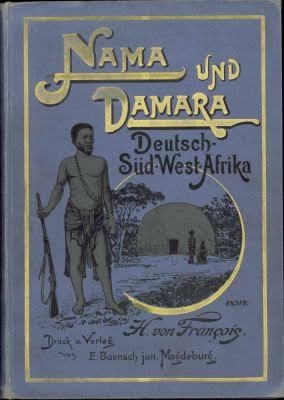
Hauptmann Hugo von Francois,  from his Nama under Damara. Deutsche Süd-West Afrika (1896)
The first German military force posted to Southwest Africa in arrived in June, 1889 and consisted of 21 officers and men under Hauptmann Curt von François (1852-1931).  The " François Troop" was actually a mercenary force under private contract for three years service, and did not formally become an imperial military force until 1894.  Hauptmann von François was accompanied by his younger brother Hugo (1861-1904) , the man with the splendid handlebar mustache, above. 

The von François brothers came an aristocratic German family of Hugenot ancestry.  Their grandfather Karl von François served against Napoleon in 1812-1813 as a junior officer with the Russian Sumschen Hussars and ended his military career as a Prussian Lieutenant General.  Their father, Generalmajor Bruno von François, died leading his division in 1870 at Spicheren, Lorraine, during the Franco-Prussian War.  Another François brother - Hermann (1856-1933) was a highly decorated  German General de Infantrie during WWI - Pour le Mérite with oak leaves - who played a decisive role in several battles on the Eastern Front including Tannenberg. 

Hugo von Francois started his military career in the 26th Regiment and was adjutant of is 2nd battalion before posting to Africa.
Schutztruppen in early uniforms with Commander Leutwein (circa. 1894-1896)
During his service in the François Troop, he was promoted to Lieutenant (1891) and Hauptmann (1896).  In his portrait photograph he wears a brown corduroy dress uniform with the pips of an oberleutnant on his shoulder and a spiked pith helmet, That style of helmet is also visible in the photograph at right from the archives of the Polytechnic Institute of Namibia, which shows a number of Schutztruppen with Theodor Leutwein, who replaced Curt von François in 1894.  Most of these men are in early (1891-1896) Schutztruppe cord uniforms with Polish-style pointed cuffs, but there are two spiked pith helmets worn by the men standing at the extreme left and right of this group.

Hugo von François wrote Nama und Damara: Deutsche Süd-West Afrika (1896) in which he promotes the development of the colony by utilizing native labor (and cattle).  It includes many photographs and illustrations not often seen in other contemporary accounts, such as this non-commissioned officer mounted "Herero-style" on a bull.

Curt von François only spent five years in German Southwest Africa, but his brother Hugo, who later served in 4. Grenadier Regiment, retiring from from military service in 1899, returned as a settler with his family in 1901.  He was a Captain in the Reserves when the German-Herero war began.  He moved his family to Windhoek and prepared its defense.  In February, 1904, he accompanied the Ost-Abteilung under Major von Glasenapp and was killed on March 13th at Owikokorero.

Tuesday, November 19, 2013

"Alte Afrikaners"


Here are three "old Africans" in a German photograph dated 1895 and published in 1914 in Aus der Geschichte der Schutztruppe für Südwestafrika by Alexander Cormans.  Two of them are officers in the Southwest Africa Schutztruppe, and one a civil servant and the first civilian to hold the post of Governor in this German colony.

The officer at left in the 1894 issue field cap is Oberleutnant Otto Eggers, though probably just a lieutenant when this picture was taken.  He was very young when he came to Southwest Africa in 1894, though it is hard to credit that he was as young as sixteen, if we go by the vital statistics presented for him by Klaus Dierks. He was formerly in the Lower Saxony Field Artillery Regiment No. 46, and served as Besirkschef at Okahandja.  Eggers wrote a journal that was posthumously published, for he was among the officers and men of Maj. von Glasenapp's East Section killed at Owikokorero on March 13th, 1904.

The man at the center is Dr. Friedrich von Lindquist, who arrived in the colony at the end of 1893.  As one of Governor Leutwein's deputies he was responsible for administering the central Windhoek district and was also a judge.  Lindquist was appointed a German consular officer at Cape Town during the Boer War in 1900 and promoted to consular General  in 1902.  He succeeded Lt. Gen. Lothar von Trotha as Governor of Southwest Africa in 1905 during the Nama uprising and remained in the colony until 1908.  He actively promoted the introduction of karakul sheep farming and established a vast wildlife reserve in Northwestern Namibia in 1907 that included what is now Etosha National Park.

The officer at right in the 1891 issue kepi is identified as Major Schwabe.  Kurd Schwabe arrived in the colony as a Leutenant in 1893, and held Haupmann's rank as late as 1903.  He participated in military operations against the Witbooi Nama and the ovambanderu and served as Besirkschef in Okahandja and Otjimbingue before leaving Southwest Africa in 1897.  He subsequently served in the Seebataillon during the Boxer Rebellion and returned to Africa during the Herero War (I believe as an adjutant and staff officer).  Schwabe wrote extensively on colonial warfare and his various campaigns and taking a large number of photographs during his travels.  Oberstleutnant Schwabe died in 1920 of hepatitis contracted during WWI in Palestine.

Friday, November 8, 2013

Ludwig von Estorff: "Crushing the People like this was in Equal Measure Cruel and Insane" (Part II)

Major Ludwig von Estorff's Westabteilung fought an engagement against the Herero on March 16th, 1904 at  Omusema, and later coordinated with the Main section under Governor Leutwein in a brief and unsuccessful campaign that included engagements at Onganjira on April 9th and Owiumbo.  In the first of these engagements, a young staff officer Oberleutnant Otto von Estorff of II Seebataillon  was killed.  Born in 1872, was the youngest brother of Major von Estorff. 

After the June troop build up and reorganization of the Schutztruppe into two regiments, Estorff was given command of a battalion of three companies in Lieutenant Colonel Mueller's 1st Field Regiment. 

During the Waterberg campaign, Estorff's command consisted of 26 officers, 247 enlisted men, four artillery pieces and four machine guns.  According to German sources*, Section von Estorff contained 3 Schutztruppe companies from the 1st Field Regiment.  These were the 1st Field Company under Hauptmann Graf zu Solms-Wildenfels, the 2nd field company under Oberleutnant Franz Hermann Ritter, and the veteran 4th Field Company under Hauptmann Franz Ritter von Epp. He had native auxiliaries as well, from the Rehoboth "Bastards", under Oberleutnant Böttlin.

For artillery Estorff had the 3rd Field Battery with its C73 field guns under Oberleutnant Bauszus, and a machine gun section of 4 machine guns under Leutnant Graf von Saurma-Jeltf.  The records indicate a radio section as well, although the main means of communication at in this campaign was via heliograph so perhaps that is what was indicated.

Estorff's section was detailed to advance of the Herero below the Waterberg from the East, and fought an action at Otjosongombe where his artillery was used to good effect.  After the fighting at the Waterberg, Estorff's Section was tasked with pursuing the Herero through the Omaheke Sandveld, and it was this experience and the extermination order given by Lieutenant General von Trotha that Estorff felt seemed both extreme and unwise:

"crushing the people like this was in equal measure cruel and insane.  One could have saved many of them and their herds, if one had spared them and given them refuge; they had been punished enough.  I suggested this to General von Trotha, but he wanted their complete destruction."

Estorff's vision of a pacified and subjugated people integrated into the colonial system as a source of labor and livestock was harsh and destructive, but it was less extreme than the genocidal policy aggressively pursued by von Trotha with both the Herero and later the Nama.  Estorff also felt his personal honor was at stake when he promised starving bands of Herero that they would not be harmed only to see them charged with murder and executed.  During the war with the Nama,  Estorff was so appalled by conditions in the Shark Island prison camp with its 90% death rate that he closed it down and moved the survivors inland.

Promoted to Oberstleutnant in 1906 and commandant of a 4,000 strong Schutztruppe in 1907, Estorff served in Southwest Africa until 1910 when he was succeeded as Schutztruppe commander by Joachim von Heydenbreck.  

At the outset of World War I,  now Major General Ludwig von Estorff  lead an infantry Brigade with the 5th Army (Crown Prince) on the Western Front and was severely wounded at Dannevoux.  The next year he commanded the new 103rd Infantry Division on the Eastern Front (his brother Maj. General Eggert von Estorff was killed in Russian that March).  He was promoted to Lieutenant General in 1916 and later assumed command of the 42nd Infantry Division.  He received his highest military decoration, the Pour le Mérite, in September, 1917.
After the war, Ludwig von Estorff was involved in the unsuccessful Kapp Putsch, and when this failed he was relieved of his command and placed on inactive status.  A deeply religious man, late in life he was associated with German theologian and public health advocate Friedrich von Bodelschwingh, who opposed some of the more extreme policies of the Nazis. 

Estorff was a Prussian aristocrat and a conservative military man, and it would be a mistake to make him out to have been either a defender of human rights or an ardent opponent of Hitler.  In August, 1939 on Tannenburg Remembrance Day, he and many other veteran officers were given the brevet rank of General der Infanterie, which would not have been the case had he been out of favor with the Nazis at this time.    It is not clear to what degree he actively worked against the Nazis in his last years of life.


*Die Kämpfe der deutschen Truppen in Südwestafrika bearbeitet von der kriegsgeschichtlichen Abteilung 1 des Großen Generalstabs Band 1: Die Kämpfe gegen die Hereros Berlin 1906)


Wednesday, November 6, 2013

Major Ludwig von Estorff: "Der Letzte Römer" (Part I)

When I lived in northwest Namibia, in the shadow of the Grootberg, there was an adjacent farm

called Estorff.  A few miles up the dry Kakatswa River was a stone kraal and the remnants of a mud walled fort once occupied by Captain Estorff of the Schutztruppe during operations against the Topnaar Nama in the 1890s.  Ludwig von Estorff was one of the most prominent - and intriguing - Colonial German officers in Southwest Africa.  He was highly decorated (one of the very few recipients of the "Prussian Quartet" of decorations that include the Order "Pour le Mérite" (PlM), the Order of the Red Eagle (RAO), Order of the Crown (KO) and the Royal House Order of Hohenzollern (HHO).  He took an active part in many of the battles in the Herero and Nama wars, but he also spoke out against the excessive campaign of extermination pursued in Southwest Africa,  and near the end of his long life was an opponent of the Nazis.
He came from an ancient Lower Saxon noble family, the son of a Major General, and in the course of his long military career he rose from Sekonte-Lieutenant to Brevet General der Infanterie.  Estorff joined the Schutztruppe in Southwest Africa in 1894, serving as Captain of a company based at Outjo.  He left to join the Great General Staff in 1899, but was soon serving as Major in the East Afrika Schutztruppe, then as a military observer in South Africa in 1901 during the Boer War and as Deputy Commander of the Schutztruppe in Southwest Africa.  He left Africa later in 1903 when he was appointed Battalion Commander in the Füsilier Regiment Prinz Heinrich von Preußen, but returned to Southwest Africa at the outbreak of the war and was in the field by mid February, 1904.

He arrived to learn that his former batman or bambuse, a Herero man named Sepp, had been killed while fighting alongside Captain Franke's 2nd field company.  Estorff erected a headstone over the grave of his old servant with a verse from Revelations and an inscription in German which may be translated:

"My dear faithful unto death servant, the Herero Sepp, fell on 4 February 1904 in the battle for Omaruru.  Von Estorff, Major."

Estorff initially commanded the Westabteilung, a detachment that included two veteran Schutztruppe companies (the 2nd under Franke and the 4th under von Schönau), a newly arrived seebataillon company (Haering), four field pieces, a mountain gun, and two machine guns. With this force he marched toward Omaruru and Outjo, and on February 25th part of this force fought a ten hour engagement with the Omaruru Herero at Otjihinamaparero. This action produced few casualties and only served to further concentrate Herero forces eastward, but was lauded as a great victory when so much of the war news was verging on disaster. 

His men called him "Der letzte Römer", the Last or Old Roman, and this did not mean they saw him as a martinet but rather one of the old warriors reminiscent of an earlier age. We will continue with the second part of this brief biography of Maj. von Estorff in a subsequent post.