Showing posts with label Personalities. Show all posts

Friday, July 25, 2014

The Commanders at Uitkomst: Oberleutnant Richard D. Volkmann (Battle of Uikomst Part II)

Richard D. Volkmann was one of the "Alte Afrikaners", an old Africa hand of the German Protection Force in Colonial Southwest Africa.  He came to the colony in April, 1894 as a Lieutenant in the Schutztruppe, arriving in time to join the fight against Hendrick Witbooi in the Naukluft mountains.  He left twelve years later during in the Nama War in 1906 with the rank of Hauptmann and the thanks of his Kaiser after undertaking a campaign  in which he captured Kaptein Cornelius Fredericks and his followers from Bethanie.  During his service he held administrative posts of responsibility, was a Lieutenant in Hauptmann Ludwig von Estorff's Feldkompanie, and explored the far reaches of the Colony in the remote Caprivi Strip, that panhandle of territory extending deep into the interior of the subcontinent and connecting to the Zambezi River.

His most important posts, however, were those of District Chief: first in Omaruru (1894-1898) and later in the Military District of Grootfontein (1899-1904).  Especially during the latter assignment, with only a small Schutztruppe force of less than 25 men augmented by some 15 native police, he was expected to cover a vast territory at the northern extent of German administrative control, protecting settlers, traders and missionaries, managing relations with the indigenous population, and exploring the hinterland. 

In 1903, in response to the expulsion (and a killing) of some European traders and Catholic missionaries  from the Uakwangali territory in the Kavango Region located in the far Northeast  near the Caprivi Strip, now Oberleutnant Volkmann lead an armed force against Uakwangali King Hompa Himarwa Ithete and his nephew Kandjimi Hawanga zaShikongo.  After clashes with the local population, including a fight with the Uakwangali King on July 16, 1903, he reached Andara and secured permission from Mbukushu Chief Diyeye to found a Catholic mission.

Volkmann also established the first German military post at Fort Namutoni (Amutoni), the strategic water hole at the eastern edge of the vast Etosha Pan, which controlled access to the vast Oshiwambo-speaking kingdoms beyond.  Namutoni represented the furthest extent of the German military presence in the District.  It was here on the 28th of January, 1904, that 500 Owambo warriors under King Nahale of the Ndonga attacked the outpost's four Schutztruppen defenders and three reservists.  Lead by Unteroffizier Fritz Großmann, these soldiers were able to withdraw under cover of darkness toward Tsumeb and safety.  This was the only reported instance of the Owambo attacking the Germans during the Herero uprising, though they did shelter some Herero refugees who gained their territory after the battles at the Waterberg.

Along with some of his contemporaries, including von Estorff, Hauptmann Victor Franke, Hauptmann Kurt Streitwolf and others, Volkmann generally viewed the Herero (and their wealth of cattle) as important resources for the development of the colony.  He certainly seems to have commanded the respect and loyalty of those Herero who served in his District Police force at the outset of hostilities in 1904.  According to former East German historian Helmut Bley;

"Only Lieutenant Volkmann, Divisional Commander in Grootfontein, far away from the centre of the revolt, managed to establish real relationships.  His success is - among other things - a sign of the way in which German officers brought the Africans into their own ethos.  Volkmann had recruited fifteen young men from respected Herero families into the police force.  When news of the revolt reached Grootfontein, Volkmann gave these men the option of leaving the force, since he did not wish to force them to fight against their own people.  They were, he said, entirely free to leave, but he would 'solemnly curse anyone who leaves.'  Volkmann's standing among the Herero was such that they all remained to take part in the fighting (Bley, Namibia Under German Rule, pg. 179)."

This, then,  was the man in charge in the Grootfontein District at the outbreak of hostilities with the Herero in 1904.  He was a confident and strong willed leader who would go on to play a significant role later that year in August helping to contain the Herero forces at the Waterberg, leading a 200 man section that included a detachment that on his orders established a heliograph station on the very top of the plateau escarpment overlooking the enemy and the converging German sections below.  

That January, though, as news came in the Hereros has risen in arms and frightened settlers converged on Grootfontein from their remote farmsteads, Volkmann was worried about a significant enemy force gathering in the dolomite mountains not far to the West of town near a farm known as Uitkomst that belonged to a Boer named Joubert.    They were lead by a man the Germans knew well: one of the wealthiest and most influential of the leaders of the North Hereros in that region.  His name was Mbatona (spelled variously Batona/Batonna in the German sources), and we will discuss this enigmatic figure and the scanty biographical details that I've been able to glean from a few German sources, in a subsequent post in this series on the Battle of Uitkomst.


Sunday, March 2, 2014

Hauptmann Hugo von François

Hauptmann Hugo von Francois,  from his Nama under Damara. Deutsche Süd-West Afrika (1896)
The first German military force posted to Southwest Africa in arrived in June, 1889 and consisted of 21 officers and men under Hauptmann Curt von François (1852-1931).  The " François Troop" was actually a mercenary force under private contract for three years service, and did not formally become an imperial military force until 1894.  Hauptmann von François was accompanied by his younger brother Hugo (1861-1904) , the man with the splendid handlebar mustache, above. 

The von François brothers came an aristocratic German family of Hugenot ancestry.  Their grandfather Karl von François served against Napoleon in 1812-1813 as a junior officer with the Russian Sumschen Hussars and ended his military career as a Prussian Lieutenant General.  Their father, Generalmajor Bruno von François, died leading his division in 1870 at Spicheren, Lorraine, during the Franco-Prussian War.  Another François brother - Hermann (1856-1933) was a highly decorated  German General de Infantrie during WWI - Pour le Mérite with oak leaves - who played a decisive role in several battles on the Eastern Front including Tannenberg. 

Hugo von Francois started his military career in the 26th Regiment and was adjutant of is 2nd battalion before posting to Africa.
Schutztruppen in early uniforms with Commander Leutwein (circa. 1894-1896)
During his service in the François Troop, he was promoted to Lieutenant (1891) and Hauptmann (1896).  In his portrait photograph he wears a brown corduroy dress uniform with the pips of an oberleutnant on his shoulder and a spiked pith helmet, That style of helmet is also visible in the photograph at right from the archives of the Polytechnic Institute of Namibia, which shows a number of Schutztruppen with Theodor Leutwein, who replaced Curt von François in 1894.  Most of these men are in early (1891-1896) Schutztruppe cord uniforms with Polish-style pointed cuffs, but there are two spiked pith helmets worn by the men standing at the extreme left and right of this group.

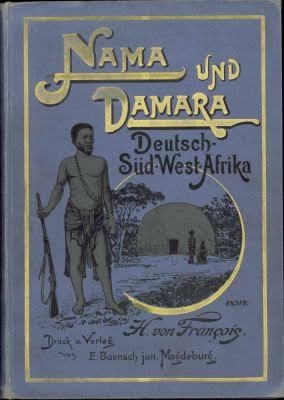
Hugo von François wrote Nama und Damara: Deutsche Süd-West Afrika (1896) in which he promotes the development of the colony by utilizing native labor (and cattle).  It includes many photographs and illustrations not often seen in other contemporary accounts, such as this non-commissioned officer mounted "Herero-style" on a bull.

Curt von François only spent five years in German Southwest Africa, but his brother Hugo, who later served in 4. Grenadier Regiment, retiring from from military service in 1899, returned as a settler with his family in 1901.  He was a Captain in the Reserves when the German-Herero war began.  He moved his family to Windhoek and prepared its defense.  In February, 1904, he accompanied the Ost-Abteilung under Major von Glasenapp and was killed on March 13th at Owikokorero.

Thursday, January 30, 2014

Images of Herero Leaders: Tjetjo Kandji and Traugott Tjetjo

Tjetjo Kandji in dark coat, center, and his son Traugott Tjetjo on the white horse
This is one of my favorite images of Herero leaders from the German colonial period in Southwest Africa.  I cannot find an electronic version of it online without watermarks, and if you expand this one you will see a faint white grid superimposed across the photograph.  Originals are in the United Evangelical Mission Archives, Wuppertal. There is also second variant of this image, in which the man next to the chicken has moved slightly and the riders are oriented on a slightly different angle.

The man on the dark horse at the center of the image, wearing a dark coat and with a kerchief under his hat, is Tjetjo Kandji, a leader of an eastern group of Hereros.  His son Traugott Tjetjo is also in the image.  He rides a white horse and wears a sash over his uniform.  There is no way to be certain in this black and white photograph, but it could be the red sash worn as a badge of office by those service as police in German Southwest Africa.   The photograph itself may have been taken in the mid 1890s, during the boundary dispute over which areas would be reserved for African settlement and those that would be restricted for the colonists.

These two men were central, tragic figures in the dispossession of the Herero in Southwest Africa, but also skilled military leaders who dealt the Germans one of their greatest battlefield defeats of the 1904 war.  

Tjetjo unsuccessfully opposed Governor Leutwein's elevation of  Samuel Maharero as paramount chief, contrary to Herero dual descent inheritance and clan structures. He inherited most of the wealth of Maharero Tjamuaha through matrilineal (Eanda) descent, and supported the old chief's half brother and war leader, Riarua , over Samuel Mahareo as Herero chief at Okahandja.  The Germans backed Samuel, however, and Tjetjo was eventually compelled to surrender other inherited cattle to Samuel in 1895 and to recognize him as his paramount chief. 

Following the German war in 1896 with the Otjiherero-speaking Ovambanderu people and their Namaqua allies the Khauas-Khoi, one of Samuel's lieutenant's, Kajata, moved into Tjetjo's territory on the Black Nossob and raided the cattle of his followers.  Traugott Tjetjo retaliated and rode with the Germans on cattle raids of their own.  Several hundred Mbanderu were disarmed and placed under his control after one raid.  These cattle raids were instigated to offset the devastating lose of Herero herds to the Rinderpest outbreak and were necessitated to pay off debts to European traders, which was a factor contributing to the tension and resentment that lead to the German-Herero war of 1904.  In 1899, the Germans moved to disarm Tjetjo and Traugott's people because they refused to register their rifles.

 In early January, 1904, Tjetjo was in the Gobabis district. On January 6th, less than a week before the opening of hostilities, Tjetjo met with Kurt Streitwolf , a German official who reported afterward to his superiors that he believed that war was not imminent. 

Tjetjo's people represented a considerable force, estimated in February by Streitwolf to have at least 1,000 men (with 500 rifles) moving from Kehoro toward the Onjati Mountains.  Governor Leutwein sent the Ostabteilung under Seebataillon Major von Glasnapp to prevent them from escaping to Bechuanaland.  Instead, Tjetjo and his band stayed ahead of the Germans, moving north.  Tjetjo ultimately rounded on them at Owikokerero, where an advance party of the Germans, including a large number of officers, suffered heavy casualties.  A second battle between Tjetjo's people and von Glasnapp's force at Okaharui ended the campaign for the Ostabteilung.

After the battle of Hamakari,  Tjetjo and Traugott and another chief called Mambo retreated along the dry Eiseb River into the Omaheke desert.  They travelled seperately from the main Herero groups under Samuel and his other followers, and were vulnerable both to thirst and to the pursuing Germans.  Major von Estorff's column attacked Tjetjo's people at Owinuau Naua and forced them to flee further into the desert.  Tjetjo ultimately died of thirst near a waterhole called Oruaromunjo.  Mambo is reported to have died of exhaustion, and Traugott Tjetjo is also believed to have died along with so many others trying to reach Bechuanaland.

Wednesday, January 29, 2014

Images of Herero Leaders: Mbandjo/Bandju.

from an 1897 woodblock engraving
One of the less well known African leaders from the period of the German - Herero War of 1904 was Mbandjo (Banjo/ Bandju), the headman of the Herero who lived in the vicinity of Otjombonde, a few days travel to the north of Omaruru. 

Mbandjo was the leader of a  northern Herero community that followed traditional practices rather than Christianity. The woodcut at left shows him as he appeared in 1897, wearing the regalia of a Herero headman, including a necklace of large white seashells.

Mbandjo is mentioned in the Journal of Gustaf De Vylder, a naturalist and trader who made several excursions in Hereroland in the mid 1870s.  During a trek made by ox wagon between Omaruru and Otjozondjupa near the Waterberg, De Vylder notes that while stopped at Ondombo:  "The chief, Bandju, came and begged as usual for everything he saw.  He selected a rifle that he said he wished to buy."  The next day De Vylder "bought a 'kru' bird from Banju for a rifled musket." 

Aside from illustrating the complex mercantile system that influenced and affected the economy of traditional  Herero communities during this period, De Vylder's account also shows that he had met Mbanjo before and that as a European trader he viewed the Africa leader's interest in receiving a gift of valuable trade goods with disdain.

Mbandjo was still the headman of the Otjombonde Herero at the time of the Rinderpest
outbreak in 1897, and is described in German accounts as allowing his herds to be vaccinated and his sick cattle shot for their gall to be used for inoculation.  Around this same period, most likely at the same time that the portrait was made, above, another image was taken of Mbandjo and his family,  later reproduced as the fancifully tinted German colonial postcard, at right.

I have not yet determined Chief Mbandjo's and his followers movements  prior to the battle of Hamakari at the Waterberg.  Possibly he fought against Captain Franke's 2nd Feldcompanie at Omaruru in February or against Estorff's Westabteilung at Otjihaenamaperero in March, 1904.  Captured Herero leader Zacharias Zeraua reported under interrogation that during the flight through the Omaheke, Mbandjo was among the Herero leaders who were gathered at Osombo Onjatu on the Eiseb River in September.  Subsequent margin notes on his testimony thought by historian Jan-Bart Gewald to have been made by Major Ludwig von Estorff indicate that Mbanjo was dead, and one of his sons, Moses Mbandjo or M'Buanjo, was among the leaders of the Herero survivors who returned to Southwest Africa after the South African invasion in 1915 and later headman in Omaruru. 

Sunday, December 15, 2013

Images of Herero Leaders: Assa (Asser) Riarua

Asser Riarua (2nd from left): Photo courtesy Wecke and Voights Collection
Modern histories of the German - Herero conflict in Southwest Africa often confuse Assa (or Asser) Riarua with his father, Riarua, including mislabeling images of the senior with the name of the junior.  The photograph shown at left, from the archives of the Namibian store chain Weche & Voigts, is the only one I have located online that I believe correctly identifies Assa Riarua.  I have also come across a reference to another image in the Namibian Archives (No. 1288) taken in 1901 that aparently shows him wearing a hat with a light colored band alongside Samuel Mahahero and the Nama leader Barnabas, but I have not had the opportunity to view it.

The elder Riarua had been the supreme military commander and adviser to his half brother, the Herero chief Maharero kaTjamuaha (who died in 1890).  After the death of the chief in 1890, Riarua was a rival claimant against Maharero's christian son Samuel Maharero, for the chieftaincy of the Okahandja Herero and other inheritance rights. Traditional leaders backed Riarua, but Samuel Maharero had the backing of the German authorities and the Rhenish missionaries, however, and was ultimately recognized by them as paramount chief of the Herero.

Assa Riarua (b. 1848) was a close friend of Samuel Maharero's who as his veld-cornet or under captain lead his forces against the Nama Kaptein Henrick Witbooi in 1892, and later rallied with him in 1894 when Riarua and his supporters challenged his position as paramount chief.  There is a wonderful description in Jan-Bart Gewald's (1999) Herero Heroes of a reenforcing German column approaching its ally Samuel Maharero's hilltop laager, surrounded by its hedge of thorn and with the Imperial German flag flying above, and being met by "Assa Riarua, who, dressed in the uniform of the German Kaiser's French Guard regiment, told them that Samuel would be joining them as soon as he had finished conducting a field church service." 

Backed by German firepower and with the assistance of Assa Riarua, Samuel was able to compel the elder Riarua to relinquish all his claims to Maharero kaTjiamuaha's inheritance.  Why Assa Riarua chose to support Samuel over his father is a question that deserves further study, though his mission upbringing and the complexities of Herero clan inheritance structures may have been factors.  He might also have seen alliance with Samuel as a path to wealth, and indeed he lead Herero forces along side the Germans in 1895 during the boundary dispute with rival eastern Herero and ovambanderu.

Both Assa Riarua and Samuel were heavily indebted to German traders.  Assa Riarua continued to have difficulties with German merchants, one of whom later forcibly ejected him from a bakery in Windhoek and beat him bloody in the street.  In 1903, Assa Riarua and his followers in Okahandja vocally resisted German encroachment on Herero lands when a proposed native reserve left them with too little territory, unsuitable for grazing, and outside their customary areas of residence.  The reserves were finalized despite these objections and the crisis with the German authorities worsened. Neither Samuel nor Assa Riarua nor Governor Leutwein were available to intervene in Okahandja when misunderstandings and tensions boiled over in January, 1904 and open hostilities began.

Assa Riarua continued as one of Samuel's ablest commanders during the war with the Germans, who for their part suspected him of being the mastermind behind the "revolt".  He commanded the Herero left wing at Ongandjira, and in the early stages of the war was among the Herero leaders who granted safe passage to the German missionary Eich and a small party of German women and children.

After the battles around Waterberg in August 1904, Assa Riarua was among the Herero who fled into the Omaheke.  The captured Herero leader  Zacharius Zeraua later told the Germans that by early September, 1904, Assa Riarua was with Samuel and most of the surviving Herero leadership at a waterhole known as Osombo Onjatu on the dry Eiseb River.  His fate thereafter is unknown, but his daughter Diana Riarua survived in Botswana and reported that after Samuel's death in 1923, his spirit visited her in Christlike fashion with a message that "mine are those who will do my will."

Wednesday, November 27, 2013

Images of Herero Leaders: Kajata

This image comes from Elf Jahre Gouverneur in Deutsch-Südwestafrika, the memoirs of Theodor Gotthielf v. Leutwein, published in 1908. Although it is not possible to discern the faces of the riders, this is the only photograph I have been able to locate that includes Kajata, one of the principle leaders of the Herero people during the 1904 war with Germany. 

The photograph was taken in 1896 when Samuel Maharero (also identified in the image) and some of his followers allied with the Germans and rode against rival eastern Herero leader Nikodemus Kavikunua and his Ovambanderu allies under Kahimemua Nguvauva and the Khauas-Nama.  Hendrik Witbooi also lead a section that fought alongside the Germans in this campaign.

Kajata was a close ally of Samuel Maharero who gained power and chieftainship outside traditional inheritance structures.  Following the 1896 Mbanderu campaign, he gained lands at Otjihaenena along the ephemeral White Nossob river at the expense of the defeated eastern Herero leader Tjetjo Kandji.  He was even awarded a sword by the Germans in recognition of his bravery. 

Kajata was viewed as a favorite both of Samuel Maharero and of Governor Leutwein, who supported him when he brought charges in court against a notorious settler and debt collector Falkenhausen who had beaten up some of his people.  Some settlers complained that Leutwein was treating his native auxiliaries far better than they deserved, stating in one letter written during the Bondalswart campaign in November, 1903;

"The natives are valued above all else by the Governeur and the Berirkshauptmann.  These cannot do enough in keeping distinctions by the native riffraff.  Hendrick Witboy (sic) and his staff, Samuel Maharero, Kajata (a special favourite) are invited and showered with lavish gifts..."   [Quoted in Ritter-Peterson, H.G. I(1991) The Herrenvolk Mentality in German South West Africa 1884-1914. LDitt (History). Pretoria, University of South Africa: pg. 154]

During the German Herero war of 1904, Kajata was one of Samuel Maharero's most aggressive field commanders.  He survived the fighting at Waterberg, though I have not been able to determine his fate following the desperate flight through the Omaheke.  One of his daughters, Mukaahasera Kajata, for many years lead the women's section of the Otjiserandu or "Red Band", a paramilitary organization which parades every year at Okahanjda on Herero Day to commemorate the 1923 funeral of Samuel Maharero, honor the graves of their ancestors, and celebrate their resistance to colonialism and ultimate survival as a people.

Tuesday, November 19, 2013

"Alte Afrikaners"


Here are three "old Africans" in a German photograph dated 1895 and published in 1914 in Aus der Geschichte der Schutztruppe für Südwestafrika by Alexander Cormans.  Two of them are officers in the Southwest Africa Schutztruppe, and one a civil servant and the first civilian to hold the post of Governor in this German colony.

The officer at left in the 1894 issue field cap is Oberleutnant Otto Eggers, though probably just a lieutenant when this picture was taken.  He was very young when he came to Southwest Africa in 1894, though it is hard to credit that he was as young as sixteen, if we go by the vital statistics presented for him by Klaus Dierks. He was formerly in the Lower Saxony Field Artillery Regiment No. 46, and served as Besirkschef at Okahandja.  Eggers wrote a journal that was posthumously published, for he was among the officers and men of Maj. von Glasenapp's East Section killed at Owikokorero on March 13th, 1904.

The man at the center is Dr. Friedrich von Lindquist, who arrived in the colony at the end of 1893.  As one of Governor Leutwein's deputies he was responsible for administering the central Windhoek district and was also a judge.  Lindquist was appointed a German consular officer at Cape Town during the Boer War in 1900 and promoted to consular General  in 1902.  He succeeded Lt. Gen. Lothar von Trotha as Governor of Southwest Africa in 1905 during the Nama uprising and remained in the colony until 1908.  He actively promoted the introduction of karakul sheep farming and established a vast wildlife reserve in Northwestern Namibia in 1907 that included what is now Etosha National Park.

The officer at right in the 1891 issue kepi is identified as Major Schwabe.  Kurd Schwabe arrived in the colony as a Leutenant in 1893, and held Haupmann's rank as late as 1903.  He participated in military operations against the Witbooi Nama and the ovambanderu and served as Besirkschef in Okahandja and Otjimbingue before leaving Southwest Africa in 1897.  He subsequently served in the Seebataillon during the Boxer Rebellion and returned to Africa during the Herero War (I believe as an adjutant and staff officer).  Schwabe wrote extensively on colonial warfare and his various campaigns and taking a large number of photographs during his travels.  Oberstleutnant Schwabe died in 1920 of hepatitis contracted during WWI in Palestine.

Friday, November 8, 2013

Ludwig von Estorff: "Crushing the People like this was in Equal Measure Cruel and Insane" (Part II)

Major Ludwig von Estorff's Westabteilung fought an engagement against the Herero on March 16th, 1904 at  Omusema, and later coordinated with the Main section under Governor Leutwein in a brief and unsuccessful campaign that included engagements at Onganjira on April 9th and Owiumbo.  In the first of these engagements, a young staff officer Oberleutnant Otto von Estorff of II Seebataillon  was killed.  Born in 1872, was the youngest brother of Major von Estorff. 

After the June troop build up and reorganization of the Schutztruppe into two regiments, Estorff was given command of a battalion of three companies in Lieutenant Colonel Mueller's 1st Field Regiment. 

During the Waterberg campaign, Estorff's command consisted of 26 officers, 247 enlisted men, four artillery pieces and four machine guns.  According to German sources*, Section von Estorff contained 3 Schutztruppe companies from the 1st Field Regiment.  These were the 1st Field Company under Hauptmann Graf zu Solms-Wildenfels, the 2nd field company under Oberleutnant Franz Hermann Ritter, and the veteran 4th Field Company under Hauptmann Franz Ritter von Epp. He had native auxiliaries as well, from the Rehoboth "Bastards", under Oberleutnant Böttlin.

For artillery Estorff had the 3rd Field Battery with its C73 field guns under Oberleutnant Bauszus, and a machine gun section of 4 machine guns under Leutnant Graf von Saurma-Jeltf.  The records indicate a radio section as well, although the main means of communication at in this campaign was via heliograph so perhaps that is what was indicated.

Estorff's section was detailed to advance of the Herero below the Waterberg from the East, and fought an action at Otjosongombe where his artillery was used to good effect.  After the fighting at the Waterberg, Estorff's Section was tasked with pursuing the Herero through the Omaheke Sandveld, and it was this experience and the extermination order given by Lieutenant General von Trotha that Estorff felt seemed both extreme and unwise:

"crushing the people like this was in equal measure cruel and insane.  One could have saved many of them and their herds, if one had spared them and given them refuge; they had been punished enough.  I suggested this to General von Trotha, but he wanted their complete destruction."

Estorff's vision of a pacified and subjugated people integrated into the colonial system as a source of labor and livestock was harsh and destructive, but it was less extreme than the genocidal policy aggressively pursued by von Trotha with both the Herero and later the Nama.  Estorff also felt his personal honor was at stake when he promised starving bands of Herero that they would not be harmed only to see them charged with murder and executed.  During the war with the Nama,  Estorff was so appalled by conditions in the Shark Island prison camp with its 90% death rate that he closed it down and moved the survivors inland.

Promoted to Oberstleutnant in 1906 and commandant of a 4,000 strong Schutztruppe in 1907, Estorff served in Southwest Africa until 1910 when he was succeeded as Schutztruppe commander by Joachim von Heydenbreck.  

At the outset of World War I,  now Major General Ludwig von Estorff  lead an infantry Brigade with the 5th Army (Crown Prince) on the Western Front and was severely wounded at Dannevoux.  The next year he commanded the new 103rd Infantry Division on the Eastern Front (his brother Maj. General Eggert von Estorff was killed in Russian that March).  He was promoted to Lieutenant General in 1916 and later assumed command of the 42nd Infantry Division.  He received his highest military decoration, the Pour le Mérite, in September, 1917.
After the war, Ludwig von Estorff was involved in the unsuccessful Kapp Putsch, and when this failed he was relieved of his command and placed on inactive status.  A deeply religious man, late in life he was associated with German theologian and public health advocate Friedrich von Bodelschwingh, who opposed some of the more extreme policies of the Nazis. 

Estorff was a Prussian aristocrat and a conservative military man, and it would be a mistake to make him out to have been either a defender of human rights or an ardent opponent of Hitler.  In August, 1939 on Tannenburg Remembrance Day, he and many other veteran officers were given the brevet rank of General der Infanterie, which would not have been the case had he been out of favor with the Nazis at this time.    It is not clear to what degree he actively worked against the Nazis in his last years of life.


*Die Kämpfe der deutschen Truppen in Südwestafrika bearbeitet von der kriegsgeschichtlichen Abteilung 1 des Großen Generalstabs Band 1: Die Kämpfe gegen die Hereros Berlin 1906)


Wednesday, November 6, 2013

Major Ludwig von Estorff: "Der Letzte Römer" (Part I)

When I lived in northwest Namibia, in the shadow of the Grootberg, there was an adjacent farm

called Estorff.  A few miles up the dry Kakatswa River was a stone kraal and the remnants of a mud walled fort once occupied by Captain Estorff of the Schutztruppe during operations against the Topnaar Nama in the 1890s.  Ludwig von Estorff was one of the most prominent - and intriguing - Colonial German officers in Southwest Africa.  He was highly decorated (one of the very few recipients of the "Prussian Quartet" of decorations that include the Order "Pour le Mérite" (PlM), the Order of the Red Eagle (RAO), Order of the Crown (KO) and the Royal House Order of Hohenzollern (HHO).  He took an active part in many of the battles in the Herero and Nama wars, but he also spoke out against the excessive campaign of extermination pursued in Southwest Africa,  and near the end of his long life was an opponent of the Nazis.
He came from an ancient Lower Saxon noble family, the son of a Major General, and in the course of his long military career he rose from Sekonte-Lieutenant to Brevet General der Infanterie.  Estorff joined the Schutztruppe in Southwest Africa in 1894, serving as Captain of a company based at Outjo.  He left to join the Great General Staff in 1899, but was soon serving as Major in the East Afrika Schutztruppe, then as a military observer in South Africa in 1901 during the Boer War and as Deputy Commander of the Schutztruppe in Southwest Africa.  He left Africa later in 1903 when he was appointed Battalion Commander in the Füsilier Regiment Prinz Heinrich von Preußen, but returned to Southwest Africa at the outbreak of the war and was in the field by mid February, 1904.

He arrived to learn that his former batman or bambuse, a Herero man named Sepp, had been killed while fighting alongside Captain Franke's 2nd field company.  Estorff erected a headstone over the grave of his old servant with a verse from Revelations and an inscription in German which may be translated:

"My dear faithful unto death servant, the Herero Sepp, fell on 4 February 1904 in the battle for Omaruru.  Von Estorff, Major."

Estorff initially commanded the Westabteilung, a detachment that included two veteran Schutztruppe companies (the 2nd under Franke and the 4th under von Schönau), a newly arrived seebataillon company (Haering), four field pieces, a mountain gun, and two machine guns. With this force he marched toward Omaruru and Outjo, and on February 25th part of this force fought a ten hour engagement with the Omaruru Herero at Otjihinamaparero. This action produced few casualties and only served to further concentrate Herero forces eastward, but was lauded as a great victory when so much of the war news was verging on disaster. 

His men called him "Der letzte Römer", the Last or Old Roman, and this did not mean they saw him as a martinet but rather one of the old warriors reminiscent of an earlier age. We will continue with the second part of this brief biography of Maj. von Estorff in a subsequent post.


Thursday, October 31, 2013

Simon Kooper (ǃGomxab), The Captain in the Striped Coat

Leuntant Weiss, flanked by Simon Kooper and Henrick Witbooi
 There are several images taken together of German and Nama leaders when they were still allies that include a man with a white mustache and a vertically striped coat.  He appears at left with a Leutnant Weiss and below with Karl Henning Conrad von. Burgsdorff, as well as in a third image previously posted here.  His name was Simon Kooper, and he was one of the greatest of the Nama leaders during their 1904-1908 war with the Germans in Southwest Africa.


Bezirksamtmann v. Burgsdorff with Hendrick Witbooi and Simon Kooper
Simon Koper or Kooper, whose Nama name is !Gomxab, was part of the Fransman or ǃKharakhoen Nama who emigrated to Southwest Africa in the mid-19th century from the Northern Cape region of South Africa.  Kooper assumed the leadership of this group in 1863.  The clan was closely allied at this time to the Oorlam at Windhoek under Jonker Afrikaner.  In 1889 Kooper's people formed their main settlement at Gochas t east of Mariental.

Longtime allies of Hendrick Witbooi, Simon Kooper's Nama fought against the Germans with the Witbooi in the 1890s, and joined with the Witboois once again in the war against the Germans in 1904-1908.  In the photographs,  Kooper wears the imperial armband of Germany's native auxiliaries, but was quick to side with the Witboois when they rose up in October, 1904.

Despite his advanced age, Simon Kooper proved a tenacious are resilient guerrilla leader.  Among his reported extraordinary accomplishments, he is said not only to have survived imprisonment on the notorious Shark Island, where there was a 90% death rate, but to have actually escaped from it and returned to the field.  Although this claim requires further substantiation, there is no doubt that he fought the Germans in numerous battles alongside both the Witboois and the forces of Jakob Morenga, and that he lead the very last Nama resistance group in the field well into 1908.  The Germans actually attached him in the Bechuanaland Protectorate where he had taken refuge, and he was ultimately given a pension by the British in 1909.  He died in 1913 and is buried near Kaartle pan in Botswana.  His grave is inscribed both in German and in Damara/Nama.