Showing posts with label Artillery. Show all posts

Monday, July 17, 2017

Images of Artillery used during the German Herero-Nama Wars

7.2 cm gebirgskanone L/14 M98
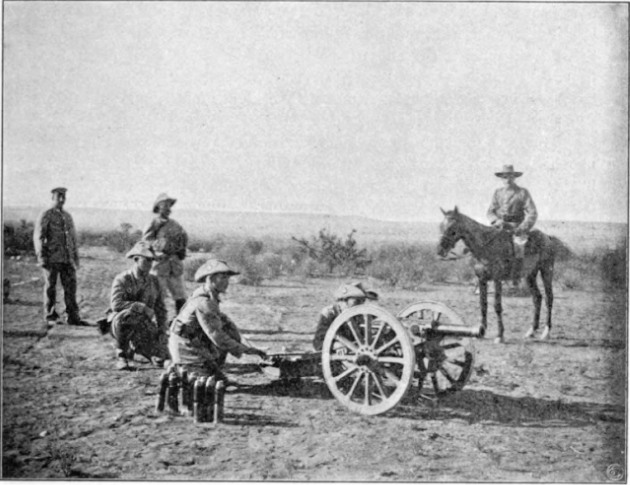
The Schutztruppe, Seebatallion and Landungskorps from S.M.S. "Habicht" had a range of artillery and machine guns available during the German/Herero War of 1904.  Other sites do an excellent job of describing most of these artillery pieces, although machine guns will require a bit more research to determine what version of the Maxim gun was provided by the navy and marines, as these branches received machine guns before they were adopted by the army in 1901.  My intention here is to briefly describe the artillery and then provide some historic photographs.

The Schutztruppe had both C73 and C96 feldkanone.  The C73 came in two calibers: 7.85 Leichte feldkanone and 8.8 cm Schwere feldkanone.   The C96 fired a 7.7cm projectile.  At the outset of the Herero war, the Schutztruppe in DSWA had five C73 Leichte feldkanone and was later reenforced with C/96aA and C/96nA field guns from Germany and two feldkanone 91/93 from Kameruun.

The colony also had at least four 5.7 cm quick firing guns or schnellfeurgeschürtzen.  Although these saw service during the Herero War as part of Battery 1 under Hauptmann v. Oertzen, I have not been able to locate any good photographs or even details about the design of these weapons.

Four mountain guns were issued to the Schutztruppe and were in service at the outbreak of the German/Herero war.  These were 7.2 cm gebirgskanone L/14 M98 and saw hard service between 1904 and 1908 when the colony received the new 7.5 cm gebirgskanone L/17 M08.

Four outdated 10.5 cm fixed recoil field howitzers (feldhaubtize M98 by Rheinmetall) were sent to Southwest Africa during the German/Herero War.

The Seebataillon and Landungskorps from S.M.S. "Habicht" contributed 2 or 3 cone-mounted 3.7 cm Gruson-Hotchkiss revolverkanone and 8 M97 Krupp 3.7cm maschinenkanone.

There were several machine gun sections, served both by marines and sailors and by Schutztruppe.


7.7cm C96 Feldkanone, Battery 5, 1904
Mountain gun emplacement
Mountain gun battery on mules
Mountain guns firing
Sailors with M97 Krupp 3.7cm Maschinenkanone on Darmstadt transport, 1904
Schutztruppen with cone mounted 3.7cm Gruson-Hotchkiss revolverkanone  from SMS Habicht
Maxim Gun: Maschinengewehr
(probably purchased in 1901)

Tuesday, June 16, 2015

New Skirmish Scenario "Incident at Osona": Armored Trains and Herero Rifles (Part IV)

Download .pdf  of Playtest Version Here
Here is the play test version of a new German-Herero War skirmish scenario I have developed for use with the Jones/Alvarado Herero Wars Scenario and Rules book (based on TSATF Rules system).  It follows on the Ambush at Uitkomst scenario I developed in collaboration with Roy Jones last year.  Previous posts on this blog in the Armored Trains and Herero Rifles in 1904 category provide the historical documentation and assumptions that inform the design of this scenario.

The German force has two significant assets that require careful handling in order to function property and upon which the success of their expedition to relieve Okahandja depends.  They have a train pushed by paired Zwillinge engines and open cars with sides that have been hastily reenforced with sandbags.  In addition two 32 Schutztruppen (4 foot elements in game terms), the train carries a machine gun in one of its open cars.  Maintaining proper speed, avoiding derailment and keeping the machine gun on line, all the while repairing sabotaged sections of track under enemy fire, presents a significant challenge for the German player, as indeed was the case during the historical Maschinengewehr-Expedition on which this scenario is based.  The train crew members are essential, and the loss of all four puts the train out of commission and means certain defeat.

The Hereros have excellent cover in the dense bushes, among nearby steep cliffs and within a large stone house, but perhaps not quite enough riflemen to pour on a devastating fire and disable track simultaneously.  In the actual fight at Osona, the tracks were broken in three places before the Germans arrived and the Hereros had perhaps as much as a 7:1 advantage in riflemen.  The numbers are reduced for this scenario, and not all of the 8 Herero Foot units are available when play begins.

Until it has been play tested, I'm not sure that I have the forces balanced appropriately, and am eager to see how new rules I have developed for causing and spotting track sabotage, derailment, track repair, train movement and cover will function.  If you decide to give this scenario a try, I would be grateful for detailed feedback on your results.  Further updates to the scenario will be posted here.

Tuesday, November 25, 2014

Images of Seesoldaten from DSWA in 1904

The Marine infantry or Seebataillon companies that arrived in German Southwest Africa in February, 1904 saw heavy service in the months to follow.  Those in the 1st Company suffered the most, taking early casualties at Swartklippe and then joining the ill-fated expedition of the Ostabteilung under marine Major von Glasenapp during which they lost dozens of men fighting as the rearguard or nachspitze at Okaharui.  The 4th Company also served in the Ostabteilung, while the 3rd was initially with Major Estorff's Westabteilung and fought a hard engagement at Otjihinamaparero and a skirmish near the Omatako Mountains on the way back to Okahandja to where Estorff joined forces with Governor Leutwein's main section or Hauptabteilung. The 2nd Company fought at Klein-Barmen and also joined the Hauptabteilung.  

Seesoldaten with the Ostabteilung traveling in open rail trucks
(Photo from database maintained by Goethe Universität Frankfort am Main)
Typhus devastated the 1st and 4th companies, and the remnants of these units along with a detachment from the 3rd company served at Waterburg under Graf von Brockdorff.  Members of the Seebataillon's Maschinengewehre Zug under Oberieutenant zur See Wossidlo later garrisoned Fort Namutoni at the very edge of German settlement in the far north of the colony.  The Seebataillon also provided medical staff to the German forces.

(Photo from database maintained by Goethe Universität Frankfort am Main)
There are more images of the Seebataillon forces in DSWA than I have located for the sailors in Landungskorps Habicht that I wrote about in the previous post.  Most of these are from the 1st or 4th Companies, though there is at least one from the 3rd Company with Estorffs Westabgteilung.  In this image at left, the overall commander of the Seebataillon in DSWA, Oberst Dürr can be seen together with his staff and naval officers on board the troop ransport ship en route to the colony.

Marine uniforms can be distinguished from those of the Schutztruppe by their bordtfeld tropenhelms (with or without helmet plates) or the white bands on the visored feldmutz that appear lighter in period photographs than the cornflower blue of the Schutztruppe.  Instead of cord shoulder straps in imperial colors, seesoldaten wore detachable white shoulder boards with a gold crown and crossed anchors, but these appear to have been removed while on campaign. There are also differences in NCO insignia.

Crossing the Black Nossob
(Photo from database maintained by Goethe Universität Frankfort am Main)
Sometimes other types of equipment typical of the Seebatallion can be seen in the photographs, such as naval bread bags with belt clips worn by seesoldaten in the Ostabteilung, shown in the image above as marines in the 1st or 4th company cross the ephemeral Black Nossob river. In the image, below, an NCO from the 3rd Seebataillon Company (seated at right, possibly a vice-feldwebel based on his uniform collar and cuff insignia) and a detachment of marines posted near Omaruru prepare a meal while others stand watch.

Seesoldaten from the 3rd Company
(Photo from database maintained by Goethe Universität Frankfort am Main)
Below, another group of seesoldaten, this time from the 1st or 4th company,  contrives to heat numerous kettles over a single campfire.

(Photo from database maintained by Goethe Universität Frankfort am Main)


The shoulder boards of the marines in the next two images are quite distinct.  The senior NCO in the first picture, identified as feldwebel Peters, as indicated by his collar and cuff insignia.  They were both taken at Otjosazu near Okahandja. The other pictures show seesoldaten (including a junior and senior NCO), in an open train car, and another marine with a pet zebra.  Most of these pictures are made available by the University of Frankfort and are part of its outstanding digital library.

(Photo from database maintained by Goethe Universität Frankfort am Main)

(Photo from database maintained by Goethe Universität Frankfort am Main)

(Photo from database maintained by Goethe Universität Frankfort am Main)
Marines served both machine cannons (maschinenkanonen) and machine guns (machinengewehre) in southwest Africa during 1904.  Two machine guns were assigned to a section under Oberleutnant zur See Wossidlo, and dispatched north to Grootfontein in June, 1904 along with Oberleutnant von Zülow's 3rd Schutztruppe Company.  Here they met up with the District Commander Oberleutnant Richard D. Volkmann, who featured prominently a series of posts early this year on the Battle of Uitkomst.  Wossidlo had previously served with Estorff, and would later deploy his machine guns to  help defend the heliograph station which Volkmann ordered Lt. Auer to establish at the top of the Waterberg prior to the battles there in August.  In the photograph, below, taken in Grootfontein that June, Wossidlo wears his blue naval officer's coat.  From left to right, adults in this image are identified as Oberlt. Böttlin (in charge of the Bastard Abteilung); Lt. Lehman (field artillery); Frau Gathmann; Oberlt. Richard Volkmann; Werner (possibly Oberarzt Dr. Werner); Theodor Gathmann; Frau Kühnehold; Oberlt. z. See Wossidlo; Lt. Freiherr von Reibnitz; Oberlt. von Madai (field artillery) and Oberlt. v. Zülow.
(Photo from database maintained by Goethe Universität Frankfort am Main)

Sunday, November 23, 2014

Images of the Landsungskorps from S.M.S. "Habicht" in DSWA in 1904

A detachment of sailors from SMS "Habicht" was the first reenforcement to arrive in German Southwest Africa at the outbreak of the 1904 war with the Herero.   Landungskorps "Habitcht" guarded railway stations along the narrow gauge line between Swakopmund and Okahandja and fought several sharp actions at Liewenberg at Groß-Barmen.  Sailors from "Habicht" helped serve in a Machinenkanonen section with Ludwig von Estorff's Westabteilung.  Dr. Belden and two sailors from "Habicht" were killed, and Oberleutnant zur See Friedrich Hermann, was wounded at Owikokorero with the Ostabteilung. Several more died of typhus.

Several sailors visible, in both blue and white uniforms, 2 with the 1902 Bordtfeld Tropenhelm
(Photo from database maintained by Goethe Universität Frankfort am Main)


Images of sailors from Landungskorps "Habicht" are few and far between.  Those that I have been able to discover show a mix of uniforms (the white Arbeitsbluse, winter blues and perhaps even work shirts stained khaki with a dye of coffee and tobacco) and head wear (naval caps, Bordtfeld tropenhelms and even a Sudwester or two).  If there is a unifying feature it is the blue, removable naval collar, with or without a black neckerchief , and an open, V necked blouse.

Here is an image of Waldau station on the railway line a few kilometers west of Okahandja before the war began, followed by one after it had been burned and was reoccupied and fortified by Schutztruppen and sailors from the Landungskorps.  You can see two sailors in the second image, one in a Sudwester hat, and the corrugated sheet metal used to make the burned out station defensible.

Waldau Station, 1903
(Photo from database maintained by Goethe Universität Frankfort am Main)


Many of the sailors in the Landungskorps served automatic artillery pieces, including machine cannon (maschinenkanonen), revolver cannons (revolverkanonen) and machine guns (maschinenegewehre).  The following image from Okasise station on the railway line on June 30, 1904 includes a revolverkanone crew and gun platform, and includes a significant number of sailors from the Landungskorps (and one or more officers).

(Photo from database maintained by Goethe Universität Frankfort am Main)


A close up of the gun crew in this photograph (from the digital library of Goethe Universität, Frankfort am Main, which has a wealth of period images), reveals soldiers in their winter blues - appropriate for this time of year in the southern Hemisphere - and summer whites or work blouses.  The officer in front strikes a jaunty pose.

Small detachments of Sailors from the Landungskorps also served machine guns and other automatic cannons with Estorff's Westabteilung at Omaruru and with Glasenapp's Ostabteilung.  One of the former is shown, below, at the grave of  Leutnant Erich Georg Kuno Freiherr von Woellwarth-Lauterburg who died of wounds received during the siege of Omaruru on February 14th, 1904.

(Photo from database maintained by Goethe Universität Frankfort am Main)

Another sailor stands at a pair of graves, unfortunately just too pixelated for me to determine their names, in the image below. His collar is darker than his blouse but the shirt is no longer white.  It may be an example of one of the sailor uniforms that was stained khaki with coffee and tobacco.  It is just possible that the same sailor, in different clothing, appears in this photograph as the one above.  Hard to tell, but there is a resemblance...

(Photo from database maintained by Goethe Universität Frankfort am Main)

Wednesday, June 18, 2014

Lead Pile Status

I've been a tad distracted by significant life events and have not been able to paint up more of my backlog of miniatures for a month or two, but that should change soon.  I have a couple dozen Herero foot from various manufacturers (Perry, Askari, Foundry, Northstar) primed and ready to go, and I'm excited to move on to some of the German field artillery, Landungskorps and Seebataillon (and a few more scenics, including some unusual African wildlife).

On the other hand, I now have my very own copy of Dr. Roy Jones and Eric Alvarado's much anticipated Herero War Scenario and Rules Book and have been trying to restrain myself from reading it cover to cover (in case I wish to play any of these myself without knowing the other side's information).  It is a labor of love and an outstanding contribution both to this hobby and to the history of the period (some of it only available in English translation through Dr. Jones' good efforts). I am also grateful for the kind mention made of this blog more than once within their book.

The Jones/Alvarado book is based on the venerable The Sword and The Flame rules and expansions by Greenfield Hobby, also no longer in print.  Various editions pop up for sale from time to time and as I am unfamiliar with this game system I'm in the market for the 20th edition TSATF rules, or barring that the 1994 3rd edition.  I believe the Herero War rules are playable without an edition of TSATF for reference, but for someone just starting out it may prove very useful to have on hand.

I have no pressing deadline by which I need to finish painting up all the figures required for these scenarios, but I would like to start playing them this year and so I may decide to give priority to completing the orbat for some of the smaller encounters so I can take the rules out for a spin.  That could mean that some figures, like Herero mounted troops (some of which I still need to acquire in appropriate 28mm scale), will be deferred while others (Herero infiltrators and shock troops, German artillery and sailors) move ahead in the queue.

I've decided that I really like the old German colonial line of figures that sadly are no longer produced by the Honorable Lead Boiler Suit Company for my Schutztruppen, and have been adding them piecemeal to my lead pile whenever I am fortunate to find them available secondhand.  Last December I got in an international bidding war on eBay and watched three excellent sets (not especially well painted, each of 6 to 11 figures) slip through my grasp, but I did manage to get in under the wire and purchase 11 of the Schutztruppe figures (all since repainted) for a very steep price.  Yesterday I won three unopened packs with 10 of these same figures for half what they originally sold for ($10.50).  If I get enough of these, I will paint some as Hereros in captured uniforms. 


Friday, February 21, 2014

Painted Honourable Lead Boilersuit Company Schutztruppe

The Honourable Lead Boilersuit Company no longer produces 28mm figures from its German Colonial line, but I have been fortunate to find several lots on eBay that have allowed me to put both mounted and dismounted Schutztruppe in the field.  I've repainted, and in some cases rebased them, and can now put four HLBS Co. officers, a senior NCO, seven riflemen and a maxim gun team on the field, along with the first of ten painted mounted figures.  A few of these have been previewed here before, but yesterday I finished the vast majority of them and a photo gallery appears below.

There are three duplicate poses, although in one case the figure has a bread bag and canteen that its twin for some reason lacks.  I painted them in different uniforms (khaki feldrock or kord waffenrock), which is particularly striking when comparing the two officers, below.

HLBS Co. German Schutztruppe painted for Southwest Africa, 1904

Major (left) in kord waffenrock uniform; Hauptmann (right) in khaki feldrock

Three figures painted in kord waffenrock uniforms

3 figures in kord waffenrock and the same three 3 in khaki feldrock
Command Group (Hauptmann, Oberleutnant Adjutant, Hauptmann, Major, Feldwebel) and mounted Ritter

Maxim Gun team and Feldwebel


Friday, December 6, 2013

The Schutztruppe Barracks at Omaruru


This postcard shows the Schutztruppe barracks at Omaruru in German Southwest Africa.  The architecture is distinctive, and helps to identify the setting for the Shutztruppe mounted infantry and artillery pulled by mule teams in the photograph, below.


I am not sure about the provenance of this picture.  I have seen it misidentified as part of the Marine Expeditionary Force, but it clearly shows Schutztruppen.  In the foreground is a small mountain gun pulled by a six mule team and attached to a tiny limber with four ammunition boxes.  The supply cart alongside has eight mules.  There is a covered wagon in front of the veranda of the barracks at right, and the troops are in the process of forming up.  Whether they are from Franke's 2nd field company (which would be appropriate for early 1904), or another unit from the Schutztruppe, or even an image from 1915 as the Germans prepared to retreat before the Union of South Africa invasion forces of General Louis Botha, will have to await further research to determine.

Wednesday, October 30, 2013

Cone Mounted Naval 37mm Hotchkiss Revolver Cannon from HLBSC

The Landsungkorps from S.M.S HABICHT had three artillery pieces with them when they fought at Lieuwenberg and Gross-Barmen in February, 1904.  One was a C73 Krupps field gun from the Kamerun-Schutztruppe.  One was a machine gun (and this was not the most effective as it was difficult to elevate sufficiently to attack Hereros on the heights above Groß-Barmen). The last was a revolverkanone, a 37mm Hotchkiss gun likely very much like the one shown manned by the sailor in an archival photograph below.


Tabletop wargamers in 25mm / 28mm scale are in luck if they are looking for a revolver cannon for the German Herero War of 1904, perhaps to play S-233 Assault at Liewenberg: The Main Line from the upcoming Sword and Flame based rules and scenario book by Roy Jones and Eric Alvarado.
Here it is in 28mm scale in all its cone-mounted glory from the Honourable Lead Boiler Suit Company.   All it needs is a Brigade Games, Great War in Africa German sailor or two to man it, for unfortunately the HLBSC German SW Africa Colonial Line is no longer produced (and I'm not certain that it ever had German sailors even when it was).  I have ordered this revolver cannon [as well as a smaller caliber variety], and look forward to its eventual addition to the lead pile arsenal.

Update (Nov 4th, 2013):  Here is another option for a 3lb 37mm  Hotchkiss gun, revolving cannon, but  in resin, from Grandmanner.