Showing posts with label Empress. Show all posts

Saturday, November 29, 2014

The Herero Kapitän in the Coat of the Kaiser's Guard

In June, 1894, a succession dispute over the Herero chieftaincy of Okahandja turned violent.  Samuel Maharero, son of the dead chieftain Maharero Tjiamuaha, had a weaker claim under the laws of Herero inheritance than his other rivals.  Samuel and his followers were driven out of Okahandja and took refuge on a hilltop at Osona, about a dozen miles to the South.  There they ran up a German flag and waited for military aid from the colonial authorities who had backed Samuel as Herero paramount chief.  When the soldiers arrived from Windhuk, they were greeted by Samuel's cousin and veld-cornet Assa Riarua, wearing "a uniform of the German Kaiser's French Guard regiment (Jan-Bart Gewald 1999:57)."

Assa Riarua's appearance must indeed have been very striking in the Prussian cuirassier uniform of the elite Imperial Body Guard.  The regular uniform was almost cream colored white wool piped with red.  It had a red stand up collar, facings and cuffs that for the enlisted men were trimmed with white tape and for the officers in heavy silver bullion.  It is not known how Assa came by the uniform, whether it was an enlisted man's or officer's, nor whether it was complete or only included the coat.  Perhaps it was sold to him by a German trader.  The men who served in the Kaiser's guard were all at least six feet tall, and judging from a contemporary photograph taken of Assa in the late 1890s the coat would have been large for him.

A decade later during the German-Herero war, Assa fought in a German uniform and carried a sword.  By that time, his old cuirassier koller may have seen better days, but since we have a description of him wearing it in the 1890s I've decided to paint a mounted figure of Assa in the coat of the Kaiser's bodyguard.

The full uniform, it would have included the gilt helmet of the Guard du Corps, possibly

even surmounted by its ceremonial eagle with outstretched wings instead of a spike.  That seems a stretch, both from an historical point of view and as a practical matter to find a suitable figure to represent an African wearing this uniform.  There is better documentation, though, for a spiked cork sun helmet such as the Schutztruppe wore before 1896.  There is even an image from 1904 of a "Bambuse" - a German officer's native orderly - standing at a railroad siding and wearing what is probably the Schutztruppe tropical helmet authorized in 1891.  I have selected a figure to use for Assa Riarua who is wearing one as well.

I'm very fond of the sculpting that Paul Hicks has done for Empress Miniatures and its Anglo-Zulu War line, and  have used his Natal Native Horse figures (sans the spears in their shoulder quivers) for mounted Hereros.  For Assa Riarua, though, I wanted something special and selected one of two figures in a set of Mounted Natal Carbineers.


The cuffs of this figure are pointed, but a little green stuff helped to modify it satisfactorily.  I painted up Assa Riarua in the koller and trousers of an enlisted soldier in the Garde du Corps, mixing Vallejo Sand Yellow and White to get the color of his proud but well worn off white wool uniform.  I painted the old 1891 Schutztruppe spiked pith helmet with Vallejo New Wood for the darker colors, working up through German Ochre Orange with a touch of Dark Sand.  I'm pleased with the finished product, which unfortunately I had to photograph inside with the flash rather than in natural light, but the end result is a proud Herero commander in one of the most unusual uniforms ever to grace a colonial Africa gaming table.


Thursday, October 9, 2014

Back to the German-Herero War Painting Table: What's on Deck in 28mm?

The last four months spend researching and developing a skirmish scenario based on the historical battle of Uitkomst have been an exciting and rewarding interlude for me, as I hope they have been for those of you who have been following along with the 12 part series that resulted from that effort.  Although I am considering tackling a second battle scenario from this period, I don't have the bandwidth to take on that project right away: certainly not while also addressing the huge backlog of figures that await my paints and brushes.

It won't surprise readers of this blog that I now possess a large number of Boer figures in 28mm scale, mounted and on foot, that I should start painting in earnest so I can begin play testing the Uitkomst skirmish.  They are a selection of mounted (Black Tree Designs, Foundry and Redoubt) and dismounted Boers (all of the above, plus North Star Africa and Empress).  The Black Tree horsemen are just slightly larger than Foundry's but usable together.  Redoubt's are both stylistically different and as a rule slightly too small for use with Black Tree.  For Uitkomst I'll be using five of Black Tree's and three of Foundry's mounted Boers, and a probably will favor North Star and Empress for the foot figures.  Redoubt's Boer horse holder is not ideal, with extremely long legs and a rough and ready sculpt, but I have not yet found a good alternative.

I've got 12 Mounted Hereros to paint (Empress Natal Native Horse with the spears removed from their quivers), and a really neat idea for one of the Herero's most effective war leaders - Assa Riarua.  Then there are the German civilians who fought at Uitkomst (represented thus far by figures from North Star, Foundry and Redoubt), and a growing number of vehicles with draft animals, drivers and figures representing native handlers (Treiber) that are needed for scenarios such as Groß-Barmen in the Jones/Alvarado Herero War Scenario and Rules Book

I may start, however, with a scenic vignette, featuring an ubiquitous sight characteristic of the terrain in central and eastern Hereroland, along with one of its associated denizens.  It provides a welcome contrast to an otherwise flat and mundane landscape of thorn and savannah, not to mention a bit of cover.  Your guesses are welcome in the comments, but you will need to wait for the big reveal...

Sunday, January 12, 2014

First Batch of Painted and Based Herero Figures

Mix of figures from Perry, Black Tree, Foundry. North Star, Askari and Empress
This is my first effort at painting up the very large number of figures from numerous manufacturers that I have pulled together for this project.  I'm still getting a feel for both painting and basing, and this includes everything from how to get the eyes right to finding the right mix of colors.  I decided to start with the Hereros, and these are the result.

I decided to paint up examples of each of the figures I am using to represent the Herero during the German-Herero War of 1904.  They range from Empress and Askari, which are closer to 25mm, all the way up to Tiger which approaches 30mm. I am using Vallejo paint and have given them simple bases.  One or two of them were actually cast as boers but make excellent Hereros in European clothing.  I'll describe the process further in subsequent posts, but for now, here they are to enjoy.
Black Tree (from a boer set)

Perry Mafeking and Askari Herero

Tiger, North Star, Brigade Games, Foundry, Black Tree, Redoubt

Tiger, Redoubt, Foundry (some of the largest figures)

North Star Africa! range  Matabele rebels make great Herero!
Brigade Games, Black Tree and Foundry.  The rider and kneeling figure are boer sculpts.

Monday, October 28, 2013

Mustering the Troops: Hereros

There is a very large lead pile now at my house, and four more shipments expected soon to fill up the ranks. I discussed options for Herero figures in a previous post.  Here, then, is the current, unpainted Order of Battle for my Herero forces in either 25mm or 28mm scale:.


                                       Hereros


Askari Miniatures       – 10 Hereros skirmishing

Tiger Miniatures         – 5 Hereros skirmishing

Northstar Miniatures   – 4 Matabele warriors firing rifles
                                 - 8 Matabele Rebels firing muskets
                                 - 8 Matabele Rebels firing rifles
                                 - Native Cattle
                             
Brigade Games           – 8 Shutztruppe askaris in slouch hats

Foundry                    – 7 tribal musketmen in hats and coats
                                 - 8 African villagers

Perry (Mafeking)        - 6 Black armed civilians firing, standing and
                                     standing ready
                                 -6 Black armed civilians (mostly separate weapons)

Redoubt (in transit)      - 1 NNC Kneeling Firing Carbine In Jacket
                                  -1 Mounted Edendale Horse, NNH Contingent,
                                       Boot Holding Carbine
                                  -    Small Native Pony For NNH Figures
                                  -1 Sikali Horse Native On Foot Firing Carbine

Empress Miniatures      -2 Native Horse mounted (head variation)
(in transit)                    -2 Native Horse mounted (head variation
                                   -1 Native Horse horse holder and horses (4)
                                  - 4 Native Horse skirmishing

Total:  62 infantry, 5 mounted / 7 dismounted cavalry, 8 noncombatants, 3 cattle

Comments:  The Foundry tribal musketmen set (DA038) arrived with 7 figures instead of the listed 8.  The Empress native horse sets (ZWB 44, 45, 46 & 47) will stand in nicely either as Herero or Nama cavalry, but will need to have the spears removed from the quivers that are slung across their backs.  I gave the Foundry 3 rider Natal Native Horse set to the Germans to serve as native auxiliaries from the Witbooi Nama.  I will continue to add figures from Askari Miniatures to my Herero forces as they are produced.

I will share the German Colonial figures in my army in a subsequent post.

Thursday, October 24, 2013

25mm / 28mm Scale Choices for Herero War Seebataillon, Landungskorp, Native Auxilleries and Civilians

In addition to the Schutztruppe - both the "old Africans" and their hastily assembled reinforcements - the German Colonial forces in the Herero war included marine and naval troops, along with native auxiliaries, armed settlers and non-combatant teamsters.  This post examines figure options available to tabletop wargamers for this conflict in 25mm / 28mm scales.

As mentioned in a prior post, among the very first reinforcements to come ashore at Swakopmund
Brigade Games BG-WIAG17 German Sailor Command
were a landing party of sailors from the gunboat "Habitcht", followed shortly thereafter by Marine-Infanterie-Kompagnien made up of detachments from four Imperial "Seebataillon" units, along with machine gun sections that appear to have been served by elements of each of these branches of service.

The best choice for figures representing the German landing party is those offered by Brigade Games from their Great War in Africa line.  These sailors in tropical dress are 28mm figures include a 4 figure command set, two 8 figure sets in 4 poses each, and a 3 figure heavy machine gun Maxim team.  With 23 figures you have nearly half the total force of the initial landing party and may not be able to bring them all into play in most gaming scenarios, but you will be able to put forward an excellent showing of these Imperial sailors.

Copplestone Castings AFU-1 German Marines
For Seesoldaten, there are two good possibilities.  Mark Copplestone's Copplestone Castings has a Darkest Africa line that includes German marines advancing at port.  There is also a marine officer included in Copplestone's German officers pack, as well as another officer in a field cap who would paint up well for the Schutztruppe (the other three are of less value for a Herero War scenario, with two in fez and one in a non military pith helmet).  I have both sets and intend to paint the marine officer to stand in for Major von Glasenapp, the overall commander of the Marine-Infanterie in Southwest Africa who fought with the Eastern section of the Colonial forces at Owikokorero and Okaharui.

The other choice is to go with Pulp Figures.  I have several of their colonial troop sets in slouch
Pulp Figures PGS-2 German Seebataillon NCOs

hats, as well as their seebataillon set in field caps which I am intending to paint as Schutztruppe because primary sources indicate they were issued sun helmets for Southwest Africa service. The other Seebataillon from Pulp Miniatures include a four figure Maxim gun crew with officer that I intend to purchase.  They also offer a five figure Seebataillon officer set, an NCO set and a set of troops in sun helmets.  The later is dynamic and looks fun to paint, but I am not sure how they will look alongside the slimmer Copplestone figures.  As for the others, there is something a bit to cartoonish in the officer set for my taste, but I might get the NCO set if the Seesoldaten in sun helmets end up working for my layout.

There were no Askaris in Southwest Africa, and no African Auxiliaries in fez.  The Germans had three units of native allies in the Herero war.  The Wilbooi Nama sent about 80 men, mostly distinguished by armbands in Imperial colors.  Any of the limited options for mounted Hereros discussed in a prior article could serve for Witbooi Nama if armbands were added and their hats painted to appear to be covered in white cloth, with or without Imperial colored hat bands.  There were also Bethany Nama, though I can find very little about them except that the nephew of the overall commander von Trotha may have commanded them in the Waterberg campaign.  At need, either Nama group could be represented by Brigade Games Schutztruppe Askaris in slouch hats, distinguished  by painting armbands, handbands and hat covers as described above  .As for the Rehoboth "Basters", it would take some significant conversion to make a uniformed unit of these troops and I have not seen suitable figures on the market that would work for them.


There were both German and Boer settlers who fought the Herero during 1904.  The former were

North Star Africa NSA6001 - Boer Riflemen I
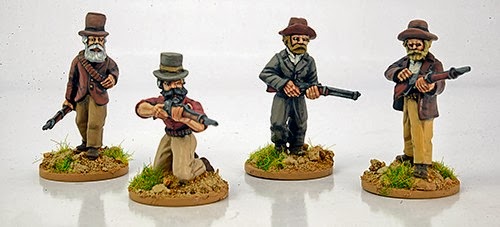
largely reservists in Schutztruppe uniforms.  As for the Boer, there are any number of manufacturers who offer both mounted and dismounted figures for South African boers as the appears between 1879 and 1902.  I am partial to Wargames Foundry Miniatures' sets from their Boer War range (DA-18/7 and 18/8), but also like those provided by Empress Miniatures for their Anglo-Zulu War Line and by North Star Africa. 
North Star also offers a boer wagon driver and native voorloper as teamsters for several authentic Boer wagons provided as laser cut wooden models by 4Ground, along with the oxen needed to pull them.  As the heavy sands of the Southwest African veld often required 18-20 oxen for a single wagon, you will want more than a two ox team to give the right impression.  I have at six on a jawbone wagon at the moment and may add two more.


Tuesday, October 15, 2013

Options in 25mm / 28mm scale to Represent Herero Forces in 1904

The Herero forces in 1904 took the field in an assortment of European clothing and were well armed with modern weapons.  They were able to deliver a rapid rate of fire, even though at the outset about about half their fighters had rifles and the rest carried knobkerries.  Their commanders made use of mounted messengers and some of the troops were mounted, although most of the engagements were fought on foot.

Finding figures in 25mm or 28 mm scale that are appropriate to represent Herero fighters can be very challenging.  Two manufacturers offer Herero figures (Tiger and Askari), and I have ordered one set from each for my table.  Several others offer African figures in elements of European dress armed with firearms that work nicely as well, but there are very few mounted troops available and some of these will require modification to be reasonably authentic representations.

Tiger Miniatures has a Colonial German Range distributed in the United States by Richard Brooks at Recreational Conflict.  Richard is great to deal with and is aware of other manufacturers to suggest to build up both German and Herero forces for this period.  I'll discuss the German figures in a subsequent post, but as for the Hereros, there are three sets available.  I chose GC-20 Herero/Hottentot, a set of five 28mm white metal figures, because none of them would require further modification to convert those wearing an inauthentic fez to the more appropriate wide brimmed hat.  They have pangas for sidearms and their heads are a tad large, but they have character and should paint up well.

   Askari Miniatures has an expanding range of German Colonials and their Herero opponents in
Askari Hereros HE-1
Southwest Africa.  These are 28mm scale and are among the most faithfully recreated figures available for this period.  There is only one Herero set currently available and it was just released.  It consists of ten figures in five poses, all wearing wide brimmed hats and all carrying captured German weapons and accoutrements.  They are delightful figures, some of which fight barefooted, and I will eagerly acquire more of them in this range if they become available.

An intriguing option to stand in for Herero fighters is available from NorthStar Military Figures in the Africa range. Northstar has a number of four figure sets in 28mm  scale depicting Matabele warriors armed with muskets or rifles, some in European articles of dress,  representing the conflict with the British South Africa Company in the 1890s.  I chose to use both sets of Matabele Rebels (NSA 1013 and NSA1014) as well as NSA 1012 (Matebele Warriors Firing Rifles).  One of the figures wears a head ring that requires removal or modification to a brimmed hat to be accurate for the Herero, but otherwise they are well sculpted and a nice fit for Herero fighters.  The NorthStar range also offers many excellent sculpts of southern African wildlife and native cattle to dress up your table.


Even more unusual are two sets made by Perry miniatures on commission for a diorama depicting the
Perry Minatures Mafeking Range MF-5

Siege of Mafeking during the 2nd Boer War that have now been made available to the public.  These 28mm figures come in sets of six and two of them represent armed black civilians carrying or firing rifles.  Two figures in the set of walking figures are in shirtsleeves and braces and wear caps that will paint up nicely as captured Schutztruppe corduroy field caps.

Brigade Games Great War in Africa range offer 28mm figures as  BGWIAG08- Schutztruppe Askaris in Shapeless Slouch Hats who while not appropriate for use in the German forces in SWA make excellent Hereros in captured uniforms.  These 8 figures in four poses are wearing puttees rather than boots but are otherwise appropriate for Herero War use.


Foundry Miniatures Darkest Africa Range, sculpted by the Perry brothers, has only one set that will work for Hereros infantry with firearms and European clothing (eight 28mm figures DA038 - Tribal
Foundry Darkest Africa DA038
Musketmen in Hats and Coats), but I also picked up DA027 - Women and Children to represent noncombatants and a set of 3 mounted Native Horsemen in European clothing from the Foundry Zulu Wars range (DA 15/6).  These latter figures will require conversion to remove the throwing spears from the quivers they carry over their shoulders, but are among the very few options available for African horsemen in the late 19th or early 20th century who can stand in for mounted Hereros or Namas. 

Another source that I am considering using that would require the same conversion are the Native Horse figures (mounted and dismounted) offered by Empress miniatures in their Anglo-Zulu War range. Beautifully sculpted in 28mm, they include a number of troops that would be suitable without the spears over their shoulders (ZWB42-48), including a horse holder with four mounts.  I did pick up a dismounted and mounted figure and horse from Redoubt Enterprises representing the Edendale Mission troop of Native Horse from the Zulu Wars that did not have the throwing assegais in the quiver.  If these prove to be good sculpts I may order more.

With these manufactures and figures as sources, there are sufficient miniatures available to put a credible force of Herero in the field representing these fighters largely as they appeared in 1904.  I would like to see other figures offered, perhaps from Askari, that include Hereros armed with knobkerries and Nama fighters in their white cloth covered hats, as well as a few more noncombatant Herero in traditional dress.  By and large, though, with some weakness in their mounted arm, the Hereros that await my table should make an excellent showing.


\